Thursday, July 8, 2010

Mythology, Media, And The Future of Hinduism


The gods of Hinduism have never been up there in some cold palace playing cruel whimsical games of fate with us humans. Instead, they have taken their place among us. They have let us call them friend, cousin, son, mother, teacher, and adore them as such. For it is only in relationships that we humans adore, and it is only in adoration that we learn the lessons of the gods: to live in friendship with ourselves and others, to attain a sense of justice in our actions, and to surrender to serenity. That is the story about our gods, and it is a story that has been told countless times over the millennia in words, songs, gestures, sculpture, and art.

Since the early 20th century, the stories of the gods have found new forms in the mass media. Indian cinema in its early years was almost entirely a mythological genre. Even when the Bombay film industry moved away from them, the thriving regional language cinemas of South India produced grand mythologicals well into the 1970s. In the 1980s, when Indian television came of age, its most popular serials were mythologicals. The media boom of recent years brought forth a new wave of animated mythological shows and movies. And for nearly four decades, one distinguished comic book series, Amar Chitra Katha, has made the stories of the gods familiar to young modern readers.

How the media retell these stories is a matter of some consequence. After all, for many Hindus, these stories are not just stories in the sense of fairy tales. These stories have been the templates for our lives, helping us see Krishna in our children or Shiva and Parvathi in our parents. We see them as more than entertainment, but how we see them today and how we will see them in the future is a crucial question. Hindu myths have survived much over the centuries through a complex form of cultural negotiation and resistance against the forces of colonialism. In the present day, mythology may not seem overtly in danger of extinction, but it will have to be thought through carefully to remain as vibrant and vital as it has been.

At present, Hindu mythology is under strain from two opposite tendencies that are not entirely unrelated to broader debates about religion and politics in India and the diaspora. There seems to be a "didactic" extreme and an "experimental" extreme in present approaches to the tales of the gods. The didactic tendency views mythology as a litany of facts about history and geography. It shows up in some of the recent animated mythological movies. The gods are depicted like pop culture superhero figures while a pedantic voice lists facts about them. The experimental tendency, on the other hand, sees mythology as open to virtually any sort of reinterpretation without regard to virtue or intent. Some artists and intellectuals espouse this view, and end up assuming that any imputation of sanctity to mythology is inherently fundamentalist.

Despite these unfortunate extremes, it is my belief that the tales of the gods, like the philosophy that is infused in them, like Hinduism as a whole, are deeper and more resilient than any constraint that our era can put on them. Commercialism may have turned mythology into a media formula, with virtually any movie being cited as a retelling of the Ramayana and Mahabharatha; politics may have rubbed the stories of the gods the wrong way, from Right and from Left, leaving out the greatness of heart in them altogether. But when we look at the history of our "myths" more accurately, we will surely find what it was about them that made them both timeless and timely for so many generations. After all, even in the relatively short span that these tales have appeared in the media, there are great contributions only beginning to be acknowledged. For instance, long before mythologicals allegedly provoked religious extremism by turning up on Indian television in the 1980s, they were sparking the spirit of Gandhi, social reform, and Indian independence in the stages and cinema halls of early 20th century India (seen in the work of film pioneers Phalke and Nagiah). The question for us to ask now is what the tales of the gods need to liberate us from in the future. In an age of terrorism, wars, environmental degradation, financial hoaxes and mass mediated delusions, the need for the tales of the gods is stronger than ever. The challenge for us is simply to tell them better.

We are already telling ourselves more stories about the gods than ever before, thanks to new media technologies. But in order to tell ourselves better stories and stories that speak as much to new concerns as to old ones, we must avoid the extremes of the present moment. There are many new voices that are rising to the sky in praise of the gods in ways that make sense to us in the 21st century. Devdutt Pattnaik's work covers anthropology, philosophy, and art but speaks to us ultimately in one simple voice, of devotion. Sanjay Patel's vision of the gods shows freshness in their form and a charming 21st century American sort of coolness to them, without straying into irreverence at that. His child gods, delightful and divine all at once, are the best image for us to think of Hinduism's popular pantheon as it leads us into the future. It is as if each god is being reborn with each child that comes onto this earth, and it is up to us to learn to live and walk worthily among them once more.

(See images from an illustrated retelling of the Hindu Ramayana myth here)

This essay is part of a series on the Future of Religion at patheos.com

Wednesday, June 23, 2010

Religious Wisdom For Facing Death

The latest article from my good friend, fellow monk, and Bhakti Center (Manhattan) president and CEO Ramnath Subramanian (Rasanath Dasa) on the Huffington Post

The silent tears at the other end said it all. "Is everything alright?" I asked Priya. I have known Dr. Priya Venkat, a pediatrician, for nine years. I was a witness to her strength and determination as she fought through many challenges in her college years. I felt a sense of satisfaction to have personally contributed to her welfare and finally see her settled in a happy married life. That is why her call was tough. Priya, who was six-months pregnant, barely managed to utter the words: "Miscarriage."

Two conspicuous emotions emerged simultaneously -- helplessness and shock. Helplessness because I could not even find the words to console her or myself, and shock because two minutes before I received that phone call, I was talking to my roommate Ari about the fragility of our life and the constant, undercover companionship of our death. Little did I realize that the conversation was just the beginning of a series of deathly events in the span of one week. The news of the miscarriage was followed by a suicide of the 17-year-old son of a good friend, the demise of my 23-year-old student who was suffering from cancer, and finally a fatal heart attack that consumed my 60-year-old cousin.

Thousands of people die every day, and the world still moves on. We read and hear about deaths and tragedies almost everyday in the news. It may grab our attention for a moment, but the sports section seems more interesting. Is death really that trivial? Or have we unconsciously or consciously tranquilized ourselves from its impact?

The topic of death has the wondrous potential of concentrating the mind. It opens up a deeper sense of inquiry into our true nature and makes us question the very purpose of our existence. The Danish philosopher Søren Kierkegaard once said that the real education of mankind means facing up to death. In most spiritual traditions, especially those from the East, the problem of death seems to open up the doorway to deeper spiritual inquiry.

The Buddha renounced his wealth and riches to seek enlightenment when he saw the unpleasant sights of disease and death and realized that he had to go through the same. Similarly, in the Bhagavad Gita, which is India's classic text on yoga and spiritual wisdom, prince Arjuna faces a similar existential crisis as he is called upon to fight a gruesome war against his own kinsmen, led by his wily and unrighteous cousin Duryodhana. Although Arjuna was a veteran of many wars, he confronted death like never before because on the opposing side were members of his own family that he deeply loved and respected, but he was forced to fight them because of political intrigue.

The first chapter of the Bhagavad Gita is called "The Yoga of Arjuna's Crisis" -- an appropriate title because the word "yoga" means "to link" or "to connect". In this chapter, Arjuna's crisis makes him connect through deep inquiry to his own identity. What follows is a beautifully composed and spiritually profound dialogue between Arjuna and his charioteer and dear friend Krishna. Although I grew up with three different editions of the Bhagavad Gita at home, this text made a much deeper impact on me after my own encounter with death.

My spiritual journey began when I first confronted the problem of death at the age of 17. After securing admission to the prestigious Indian Institute of Technology, I faced deep insecurity about the fact that all achievements in my life will be invariably stripped from me at the time of death.

The issue was like a thorn in my side until one day, during dinner, I expressed it to my mother. Very affectionately, she mentioned that I was letting such thoughts rob away my real joys of life. It is important to live in the moment and experience life to the fullest. Her affection touched my heart, but her response left me dissatisfied. I felt that her response was urging me to be in denial of the terror of death. It was like trying to enjoy a delicious, elaborate feast on the eve of a really tough exam for which I have not prepared one bit.

Although I pursued the thought for some time, the intensity waned -- helped by my own "confidence" of being able to "manage" the world. I invested myself in "hero projects" that I hoped would leave a mark in this world. It was not until my second date with death that I realized that the human brain just does not have the capacity to comprehend the magnitude of the terror.

The rendezvous occurred when I was a first year MBA student at Cornell University in September 2005. I had just finished a major exam in accounting and was one of few students in the class to secure full marks. My performance gave me complete confidence and security that I would ace my MBA program and secure a top job as an investment banker. That same afternoon I proceeded to Cornell University's medical center for a regular blood test. After the doctor obtained the required samples, I was sitting in the reception area scouring the Wall Street Journal. Suddenly, I saw darkness in front of me.

When I came to external consciousness, I heard screams all around. I was on a stretcher surrounded by a whole bunch of medical personnel frantically rushing me to the emergency room. I felt excruciating pain in my hands and feet. They were twisted in an awkward fashion and to my greatest shock I could not move them. Then I felt numbness creeping up my body from my feet. I could barely speak and my eyes were getting heavier. Much to my horror, I realized that this could well be the end. Every moment seemed dilated. My entire life began to play out in front of me like a movie. All the people that I loved and all the things that I felt deeply attached to filled up my thoughts. The pain of sudden separation from all of them was intense and tears welled up in my eyes. A distinct feeling enveloped me -- a state a despair resulting from an inevitable contradiction -- the strong desire for immortality in a situation that had mortality written all over it.

I was given heavy dosage of painkillers and other medicines and woke up 14 hours later feeling like I had run a marathon on my hands. I was relieved to be alive. Nothing else mattered at that moment. The doctors described the episode to be an extreme case of a vasovagal reaction or neurocardiogenic syncope -- an abnormal reflex to wounds or punctures that results in a blood pressure drop leading to decreased blood flow to the brain. Amazing what a harmless blood test can cause!

This experience opened my eyes to the fact that death could come at any time -- even when it is least expected. It only takes a moment for life to change by 180 degrees, and when it does, the first reaction is shock. I say shock because the built-in narcissist in the human psyche believes that he will never die; he only feels sorry for the man next to him. Freud's explanation for this was that in man's inner organic recesses he feels immortal.

I once read a story in the Mahabharata, a text on India's ancient history that resonates well with this. The great king Yudhisthira, who was very famous for his wisdom and unwavering sense of integrity, was once put to a test. He had to answer 100 questions that tested his intellect and wisdom, and his success was a matter of life and death for his dear brothers. Yudhisthira impressed his interrogator with the first 99 questions. The last and the most open-ended question of the test was, "What is the most wondrous thing in this world?" To this, the king deeply pondered and responded, "Every person sees many others around him or her die everyday, but refuses to believe that he or she will ever have to go through it. On the contrary, they make plans for a permanent settlement in this world. To me, this is the greatest wonder and the biggest irony!" Of course Yudhisthira won the contest.

Confronting the fragile nature of my existence was a very humbling experience. I realized that at the time of death, the physical body that I so carefully nurture, the adoration and distinction that I strive for and treasure as fortifications of my greatness can all get uprooted and scattered like trees in a tornado. I was forced to re-examine the reliability of social, political and financial power-linkages that gave me the sense of being grounded. Facing the truth of this situation opened up spiritual inquiry yet again. For the first time, the concepts from the Bhagavad Gita made deep and logical sense.

This experience also helped me realize that treating death in a trivial fashion may close doors to deep realizations about our very existence. Life escapes us when we huddle within the defended fortress of our invulnerability. It's not that we should be paralyzed and depressed at the thought of death and renounce enjoying the precious and deep moments that life has bestowed upon us, but not taking death seriously enough may be as good as not taking life seriously enough. It may very well rob us of the opportunity to develop the humility and gratitude to appreciate the abundant gifts of life.

One bit of profound advice that Socrates gave to his disciples was to practice dying everyday. Although this may sound impractical, the undertone to this insight is very useful -- to cultivate awareness of and face our deep-rooted insecurities, the epitome of which is death itself. Such awareness, when dealt with in a healthy and honest fashion, leads to a deliberate dismantling of our defense mechanisms of denial and repression. It makes us take life seriously enough to deliberate on our actions and makes routine activity impossible. It increases the discovery of new possibilities of choice and action and new forms of courage and endurance. It gives rise to a new and more meaningful way of life.

Sunday, June 20, 2010

In The Monastic Community by Thomas Merton


Thanks to our friend Caitanya Mangala

From The Thomas Merton Reader, edited by Thomas O'Donnell (1965)

IN THE MONASTIC COMMUNITY
One or two of the novices came up and smiled and clasped their hands together and made a kind of sign a prize fighter makes when he has just won a bout, to acknowledge the applause of his fans. It is the unofficial sign used at Gethsemani foe "Congratulations" and you won't find it in the List of Signs in the Book of Usages. So I smiled, and made one of the only signs I had found out how to make, which was "Thank you." It is easy to make and remember. You just kiss your hand. It goes back to the days when people used to kiss one another's hands out of politeness, and we make the same sign when we want to say "Please."
And so I too sank into the obscurity, the anonymity of this big Trappist family, hidden behind the walls of a monastery of which, until a couple of years before, I had never even heard.
With the white woollen habit on me, I had ceased to be a stranger - or at least a complete stranger. And that is the first thing you have to cease to be when you enter a Cistercian community. For there is no cohesion more close and more intense than that of a house full of Trappists. A Cistercian monastery is, in a very real sense, a family. And to live in it according to the Cistercian Rule and vocation, that is, according to God's will, you simply have to become one flesh, one undivided organism with all the rest of the people there.
There is no escaping the fact that monks have to live together as brothers. It is forced upon them by the rule. It is one of the most essential elements in Benedictine asceticism, and the Cistercian Fathers of the twelfth century, especially St. Bernard and St. Ailred of Rielvaux, seized upon it and emphasized it still more. In fact, so marked is the importance given to brotherly love in our monastic ideal that it occupies a crucial position in the structure of Cistercian mystical theology. The ascent of the individual soul to personal mystical union with God is made to depend, in our life, upon our ability to love one another.
We get up at two o'clock in the morning, and jostle one another in the dark trying to get a little water on our faces to wake ourselves up, and we hasten to choir bumping into one another all down the dark cloister. Then for the next two hours we have to stand next to someone who sings faster, or slower, or lower than we do. Or perhaps he has a cold, and we begin to catch it.
We kneel down, all together, to make our mental prayer. Just as you are getting settled, and beginning to get some fruit out of your prayer, your neighbor nudges you and you have to stand up and turn on the light for him so that he can consult a book.
In the canonical office you have someone next to you who turns the pages of the book too fast, and you miss half a line, and have to bend down and make the little satisfaction.
In the Scriptorium, you find a book in the Common Box that begins to interest you intensely: and then someone else gets interested in it too, and every time you want it, you find that he has got there first. Out at work you may be put to saw a log with someone who just puts his head down and closes his eyes in prayer and doesn't care how he pulls his end of the saw, so that it continually jams in the log and you have to do five times as much work as usual, with practically no result. Then you go to the refectory, and your bowl of potatoes is missing, and your neighbors do not notice it. The Usages forbid you to ask for it yourself, and so you go hungry.
All this becomes far more interesting when it happens that the same person is the person who coughs down your neck in the choir, and takes the book you want in the Scriptorium, and fails to get your portion for you at table: he may even make matters worse for you by proclaiming you in chapter for not turning on the light promptly when it is needed at meditation.
And yet it is precisely all this that is given us by God to make us solitaries, hermits, living at peace with Him within ourselves, even though we are constantly surrounded by all the others in the community.
But Cistercian life brings with it more than this negative peace. It is not merely a question of being able to live in the same house with people who might be naturally uncongenial tous: the fact is that the monks really do love one another. They really do enter into a kind of close and intimate cohesion that binds them together as true brothers. In fact, although many of them do not actually realize it explicitly, most Cistercians derive a profound consolation from the mere fact of being with the other monks. They seem not to pay any attention to one another, and yet there is a profound happiness in just being there together, sitting in the same room and reading or writing, in the presence of God Who is the only possible reason for their unity.
In a way, even the weaknesses and imperfections which we all have manage to fit in harmoniously to this picture, so that one even comes to like the habits of others that first appeared to be annoying and strange.
The Cistercians have carried communism to its ultimate limit. They not only hold their farm and monastery and all the things in it as common property, no one having a legitimate personal claim to anything so small as a handkerchief or a pin or a piece of paper, but they share all their failings and all their weaknesses and all their sicknesses of soul and body. Alter alterius onera portate: there are no people in the world who get be such experts at bearing one another's burdens as Cistercian monks. Watch a group of monks work together and see with what efficiency they take care of one another's blunders; if they are good monks, they will do it without a sign, without a change of expression, and so expeditiously that you will ask yourself if the mistake really happened after all.
The beauty of the process is in the lack of wasted motion and the absence of fake politeness. They are kind, indulgent, and gentle about it, but it is rare that you will see anybody make a big artificial fuss over the troubles of others. Those who like to have a great deal of attention paid to their woes are out of luck if they come looking for it in a Cistercian monastery. They must learn to be content with unfailing but unobtrusive assistance, kind, generous, and complete, but totally unadorned by flattery or any of the artificialities of the world.
II
Now that I had become a child of this Trappist family, I looked around the room to see my home, and my brothers sitting in it. It was a fairly large room, with six large windows opening out in three directions. On one side was a three-sided court dominated by the apse of the church and the steeple and some tall cedar trees. From this side the sun slanted into the novices' Scriptorium, bathing the two big tables with warmth and light. The novices in their white cloaks sat mostly along the walls, on the low seats under which were their private boxes. A few were at the tables, writing diligent and mysterious notes on bits of scrap paper - on dissected pieces of used envelopes and the blank backs of written pages, letters they had received, and so on.
They were a varied assortment, these novices. Some were young and tall and thin, others were middle-aged. Most of them were young. All of them looked intensely happy although their noses were red with colds, and the knuckles of the fingers which held their books were cracked wide open and bleeding with the cold.
It was wonderful, the silence, and peace, and happiness that pervaded this sunny room, where so many men were together without speaking. Far from there being any sense of restraint, of awkwardness, of strain, you felt flooded with a deep sense of ease and quiet and restful well-being. There was absolutely no kind of tension between those who sat together in silence: they were all absorbed in their books or their thoughts or their writing. And their very activities were marked by a kind of restful quality: they were not imprisoned by any fierce concentration, not driven before the face of some storm of hurry and anxiety. Their eyes rested on the page with a quiet, detached attention; or else they looked away from the book, in thought, or they entered into themselves, or wrote something down.
They were diligent, yet peaceful: busy, yet at ease, at rest. They were together, yet they were alone. They were silent, yet full of occupation: occupied, but without a trace of confusion. They were recollected, without any evidence of special concentration or strain - or at least that was the norm.
There might be two anomalies, in the midst of such peace and modesty and unaffected recollection: on the one hand, your attention might be struck by someone who appeared to be working too hard to be a saint - as if it all depended on him. On the other hand, there might be one or two who were perhaps not working hard enough, as if nothing depended on them. The former would hide himself in a corner in such a way that it made him completely obvious. And the others would have a way of standing around and making signs that still smacked of "the world" - a way of holding their head up, and staring around with their mouth open, and perhaps laughing out loud.
But most of these faces had lost all the toughness and tenseness and bitterness of the world, as well as the world's flabbiness and sensuality and conceit. The corners of these mouths were not drawn down by sarcasm or obscure, nervous antagonisms and fears. These brows were not plowed with angry or anxious lines. These eyes were perfectly clear. They did not evade your gaze, or reply to it with anything but the candor of skies, of lakes: they were unfathomable in their simplicity, and flickered with none of those lights that make men unhappy and afraid.
And yet these were perfectly ordinary men - all the usual types you find on the street of any American town. You could pick out the ones who had probably been high school football players, those who had worked delivering groceries, or perhaps had worked in garages or soda fountains. One of them, I knew, had come to the monastery out of the Marines - he was my "guardian angel," appointed to teach me how to work the big choirbooks, and to keep me from wandering into parts of the monastery where novices were not allowed to go. One or two others had been soldiers. Some of them had been to colleges and universities. Some had come from the secular priesthood, but now the accidents of their past were being effectively ironed out of them, and they were becoming simple Cistercians, dwelling in the ample folds of their white and hooded cloaks.
Yet nothing was lost that was of any value. No natural gift was lost, no natural quality was destroyed, nothing they had brought with them that could count as a talent would have to be buried here. No, everything they had was sublimated and fused into the big, vital unity of a life concentrated on the highest, the only good, in Whom all other goods are eminently contained and ultimately perfected.
I realized all this in my own case, with a kind of surprise - realized that all the things I might have given up I had really retained, in so far as they were implicit in a higher good: and the wonder of it was, that in this form they continued to give me a joy that I could no longer get out of them in the world.
I could no longer travel around in the countries of the world as I pleased; but a far vaster supernatural geography was to be opened up to me, in not so many days, that would make the whole world look cheap and small. I had left all my friends and the ruins that remained of my family; but I already knew that in Christ I had them all, and loved them all far more perfectly and effectively than I could by any human affection. And the point is: human affection was not destroyed, not rooted out of me, and it did not have to be, except in a metaphorical sense. My human affection for all the people I ever loved has lost none of its reality in the monastery, but it is submerged in a higher and more vital reality, in the unity of a vaster and deeper and more incomprehensible love, the love of God, in Whom I love them, and in Whom, paradoxicaly, I am much more closely united with them than I could be if I had stayed in the world, preferring their company to His.
And I had given up writing.
Or had I? That was the question. Everything else I had given up I retained, implicit in the higher good for which I had renounced it. Was one thing going to follow me in its proper form, or would this also follow the same way as the rest? Would I give up writing and find again all of the joy of the work which, all in all, was probably the greatest joy I had ever had short of prayer and serving God directly?
As far as I was concerned, that was my intention.
But I was wondering if God had asked it of me. I would see.
Unpublished, from the Original Manuscript of
The Seven Storey Mountain
Thursday, June 17, 2010

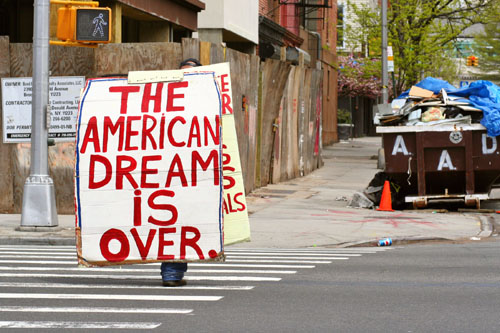
The Spiritual Progressive: The American Dream: Fact or Fiction?


From our friend Scott Manley at The Spiritual Progressive

The American Dream - Fact or Fiction?

The great American Dream first expressed by James Truslow Adams in 1931, was the idea that citizens of every rank feel that they can achieve a "better, richer, and happier life." The idea of the American Dream is rooted in the second sentence of the Declaration of Independence which states that "all men are created equal" and that they are "endowed by their Creator with certain inalienable Rights" including "Life, Liberty and the pursuit of Happiness." The American Dream has been credited with helping to build a cohesive American experience, but has also been blamed for over inflated expectations.

There are a few problems with this assumption. First of all, if “all men are created equal”, then why is the American Dream exclusively American? Then there is the problem of over inflated expectations. In the late 1800’s, Horatio Alger wrote stories of fictional characters from impoverished backgrounds who, through self-reliance and hard work, were able to realize the American Dream in this land of boundless opportunity.

The idea of self-determination and rugged individualism is idealized in the Republican party. They want less government, less government regulation, and more free market economics. This is epitomized in a story floating around the internet called “A day in the Life of Joe Republican.”

Joe gets up at 6 a.m. and fills his coffeepot with water to prepare his morning coffee. The water is clean and good because some tree-hugging liberal fought for minimum water-quality standards. With his first swallow of water, he takes his daily medication. His medications are safe to take because some stupid commie liberal fought to ensure their safety and that they work as advertised.

All but $10 of his medications are paid for by his employer's medical plan because some liberal union workers fought their employers for paid medical insurance - now Joe gets it too.

He prepares his morning breakfast, bacon and eggs. Joe's bacon is safe to eat because some girly-man liberal fought for laws to regulate the meat packing industry.

In the morning shower, Joe reaches for his shampoo. His bottle is properly labeled with each ingredient and its amount in the total contents because some crybaby liberal fought for his right to know what he was putting on his body and how much it contained.

Joe dresses, walks outside and takes a deep breath. The air he breathes is clean because some environmentalist wacko liberal fought for the laws to stop industries from polluting our air. He walks on the government-provided sidewalk to subway station for his government-subsidized ride to work. It saves him considerable money in parking and transportation fees because some fancy-pants liberal fought for affordable public transportation, which gives everyone the opportunity to be a contributor.

Joe begins his work day. He has a good job with excellent pay, medical benefits, retirement, paid holidays and vacation because some lazy liberal union members fought and died for these working standards. Joe's employer pays these standards because Joe's employer doesn't want his employees to call the union.

If Joe is hurt on the job or becomes unemployed, he'll get a worker compensation or unemployment check because some stupid liberal didn't think he should lose his home because of his temporary misfortune.

It is noontime and Joe needs to make a bank deposit so he can pay some bills. Joe's deposit is federally insured by the FSLIC because some godless liberal wanted to protect Joe's money from unscrupulous bankers who ruined the banking system before the Great Depression.

Joe has to pay his Fannie Mae-underwritten mortgage and his below-market federal student loan because some elitist liberal decided that Joe and the government would be better off if he was educated and earned more money over his lifetime. Joe also forgets that his in addition to his federally subsidized student loans, he attended a state funded university.

Joe is home from work. He plans to visit his father this evening at his farm home in the country. He gets in his car for the drive. His car is among the safest in the world because some America-hating liberal fought for car safety standards to go along with the tax-payer funded roads.

He arrives at his boyhood home. His was the third generation to live in the house financed by Farmers' Home Administration because bankers didn't want to make rural loans. The house didn't have electricity until some big-government liberal stuck his nose where it didn't belong and demanded rural electrification.

He is happy to see his father, who is now retired. His father lives on Social Security and a union pension because some wine-drinking, cheese-eating liberal made sure he could take care of himself so Joe wouldn't have to.

Joe gets back in his car for the ride home, and turns on a radio talk show. The radio host keeps saying that liberals are bad and conservatives are good. He doesn't mention that the beloved Republicans have fought against every protection and benefit Joe enjoys throughout his day. Joe agrees: "We don't need those big-government liberals ruining our lives! After all, I'm a self-made man who believes everyone should take care of themselves, just like I have."


We are addicted to this rag-to-riches myth in this country. That is why we bought into the Reagan theory of “trickle down economics.” The idea that if the rich are allowed to make as much money as they can, some of it will trickle down on the rest of us as they steal into the night with their huge bags of cash. George H. W. Bush called this “voodoo economics.” We have seen the result of 30 years of Reaganomics - the rich have gotten richer, the poor have gotten poorer, and the middle class has all but vanished.

Although this economic theory has been proven wrong time and time again, people have been brainwashed into believing that the American Dream still can apply to them too. Most people outside of America don’t live their lives based on fairy tales. They live in reality, where there are only going to be a few rich people, and you are not going to be one of them. So get used to it.

The rich have gotten richer, and as a result, they have destroyed the American Dream and have sent the world economy into a tailspin that hasn’t been seen since the great depression. The rich, instead of being drawn and quartered and hung at dawn at city gates, they have gotten a big wet kiss in the form of record tax breaks from Congress, and no one has said a word. Why? Because we’re still addicted to the Horatio Alger myth, that someday, I can make it big after all. So don’t attack the rich man, because one day that rich man may be me!

Let me burst the bubble of this myth once and for all.

The Declaration of Independence says that we are "endowed by our Creator with certain inalienable Rights" including "Life, Liberty and the pursuit of Happiness." This acknowledgement of the creator’s endowment is certainly true. Not a blade of grass can move without God’s sanction. It says nothing about how each individual is self endowed with this ability.

The ancient Vedic wisdom of the Srimad-Bhagavatam clarifies this point. The 6th Canto, 12th Chapter, 13th Verse states:

“Just as a person not inclined to die must nonetheless give up his longevity, opulence, fame and everything else at the time of death, so, at the appointed time of victory, one can gain all these when the Supreme Lord awards them by His mercy.”

In the purport, Srila Prabhupada writes,

“It is not good to be falsely puffed up, saying that by one’s own effort one has become opulent, learned, beautiful and so on. All such good fortune is achieved through the mercy of the Lord. From another point of view, no one wants to die, and no one wants to be poor or ugly. Therefore, why does the living entity, against his will, receive such unwanted troubles? It is due to the mercy or chastisement of the Supreme Personality of Godhead that one gains or loses everything material. No one is independent; everyone is dependent on the mercy or chastisement of the Supreme Lord. There is a common saying in Bengal that the Lord has ten hands. This means that He has control everywhere—in the eight directions and up and down. If He wants to take everything away from us with His ten hands, we cannot protect anything with our two hands. Similarly, if He wants to bestow benedictions upon us with His ten hands, we cannot factually receive them all with our two hands; in other words, the benedictions exceed our ambitions. The conclusion is that even though we do not wish to be separated from our possessions, sometimes the Lord forcibly takes them from us; and sometimes He showers such benedictions upon us that we are unable to receive them all. Therefore either in opulence or in distress we are not independent; everything is dependent on the sweet will of the Supreme Personality of Godhead.”

The American dream is a myth in as much as it is interpreted as being achieved as a result of one’s own endeavor, and that is the status quo belief. We must debunk this myth. It is only God who can give or take away the American Dream. Man proposes, and God disposes. We can work like asses for our own sense gratification, which is all taken away at the time of death, or we can serve God, for his pleasure. If we serve God, we will be given all that we require for our maintenance, but that should not be equated with the opulence given to those who have worked for their own selfish gratification. One type of work is binding (that of the karmi, or fruitive worker), another is liberating, (that of a devotee), who can use anything in the service of God, and is not entangled in the reactions of that labor. The devotee is free from karma, and will be liberated from the hard struggle for material existence, and go back to Godhead, to be in his constitutional position, as an eternal servant of God. The karmi will continue to rot in this material world, life after life. That is not the American Dream.

Thursday, June 10, 2010

Are There Dangers In Being "Spiritual But Not Religious?"

By John Blake, from CNN Living
June 4, 2010 1:28 p.m. EDT
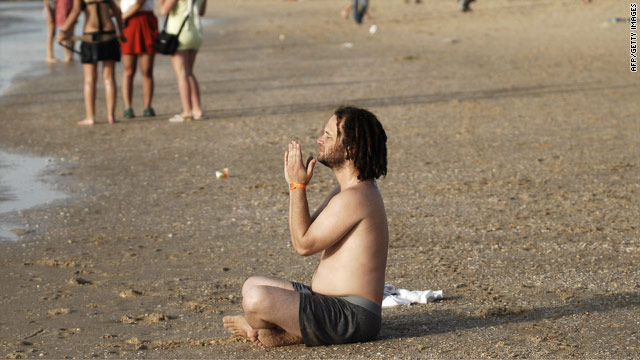
Being "spiritual but not religious" means you do not  need a church or a community, some say. A beach will do.
Being "spiritual but not religious" means you do not need a church or a community, some say. A beach will do.

(CNN)
-- "I'm spiritual but not religious."

It's a trendy phrase people often use to describe their belief that they don't need organized religion to live a life of faith.

But for Jesuit priest James Martin, the phrase also hints at something else: egotism.

"Being spiritual but not religious can lead to complacency and self-centeredness," says Martin, an editor at America, a national Catholic magazine based in New York City. "If it's just you and God in your room, and a religious community makes no demands on you, why help the poor?"

Religious debates erupt over everything from doctrine to fashion. Martin has jumped into a running debate over the "I'm spiritual but not religious" phrase.

The "I'm spiritual but not religious" community is growing so much that one pastor compared it to a movement. In a 2009 survey by the research firm LifeWay Christian Resources, 72 percent of millennials (18- to 29-year-olds) said they're "more spiritual than religious." The phrase is now so commonplace that it's spawned its own acronym ("I'm SBNR") and Facebook page: SBNR.org.

But what exactly does being "spiritual but not religious" mean, and could there be hidden dangers in living such a life?

Did you choose "Burger King Spirituality"?

Heather Cariou, a New York City-based author who calls herself spiritual instead of religious, doesn't think so. She's adopted a spirituality that blends Buddhism, Judaism and other beliefs.

"I don't need to define myself to any community by putting myself in a box labeled Baptist, or Catholic, or Muslim," she says. "When I die, I believe all my accounting will be done to God, and that when I enter the eternal realm, I will not walk though a door with a label on it."

People seem not to have the time nor the energy or interest to delve deeply into any one faith or religious tradition.
--June-Ann Greeley, theology professor

BJ Gallagher, a Huffington Post blogger who writes about spirituality, says she's SBNR because organized religion inevitably degenerates into tussles over power, ego and money.

Gallagher tells a parable to illustrate her point:

"God and the devil were walking down a path one day when God spotted something sparkling by the side of the path. He picked it up and held it in the palm of his hand.

"Ah, Truth," he said.

"Here, give it to me," the devil said. "I'll organize it."

Gallagher says there's nothing wrong with people blending insights from different faith traditions to create what she calls a "Burger King Spirituality -- have it your way."

She disputes the notion that spiritual people shun being accountable to a community.

"Twelve-step people have a brilliant spiritual community that avoids all the pitfalls of organized religion," says Gallagher, author of "The Best Way Out is Always Through."

"Each recovering addict has a 'god of our own understanding,' and there are no priests or intermediaries between you and your god. It's a spiritual community that works.''

Nazli Ekim, who works in public relations in New York City, says calling herself spiritual instead of religious is her way of taking responsibility for herself.

Ekim was born in a Muslim family and raised in Istanbul, Turkey. She prayed to Allah every night, until she was 13 and had to take religion classes in high school.Then one day, she says she had to take charge of her own beliefs.

"I had this revelation that I bow to no one, and I've been spiritually a much happier person," says Ekim, who describers herself now as a Taoist, a religious practice from ancient China that emphasizes the unity of humanity and the universe.

"I make my own mistakes and take responsibility for them. I've lied, cheated, hurt people -- sometimes on purpose. Did I ever think I will burn in hell for all eternity? I didn't. Did I feel bad and made up for my mistakes? I certainly did, but not out of fear of God."

Going on a spiritual walkabout

The debate over being spiritual rather than religious is not just about semantics. It's about survival.

Numerous surveys show the number of Americans who do not identify themselves as religious has been increasing and likely will continue to grow.

A 2008 survey conducted by Trinity College in Hartford, Connecticut, dubbed these Americans who don't identify with any religion as "Nones."

"I don't need to define myself in a box labeled Baptist, or Catholic, or Muslim."
--Heather Cariou, a spiritual but not religious seeker

Seminaries, churches, mosques and other institutions will struggle for survival if they don't somehow convince future generations that being religious isn't so bad after all, religion scholars warn.

Jennifer Walters, dean of religious life at Smith College in Massachusetts, says there's a lot of good in old-time religion.

Religious communities excel at caring for members in difficult times, encouraging members to serve others and teaching religious practices that have been tested and wrestled with for centuries, Walters says.

"Hymn-singing, forms of prayer and worship, teachings about social justice and forgiveness -- all these things are valuable elements of religious wisdom," Walters says. "Piecing it together by yourself can be done, but with great difficulty."

Being a spiritual Lone Ranger fits the tenor of our times, says June-Ann Greeley, a theology and philosophy professor.

"Religion demands that we accord to human existence some absolutes and eternal truths, and in a post-modern culture, that becomes all but impossible," says Greeley, who teaches at Sacred Heart University in Connecticut.

It's much easier for "spiritual" people to go on "spiritual walkabouts," Greeley says.

"People seem not to have the time nor the energy or interest to delve deeply into any one faith or religious tradition," Greeley says. "So they move through, collecting ideas and practices and tenets that most appeal to the self, but making no connections to groups or communities."

Being spiritual instead of religious may sound sophisticated, but the choice may ultimately come down to pettiness, says Martin, the Jesuit priest, who writes about the phrase in his book, "The Jesuit Guide to (Almost Everything)."

"Religion is hard," he says. "Sometimes it's just too much work. People don't feel like it. I have better things to do with my time. It's plain old laziness."