From our friend Scott Manley at The Spiritual Progressive
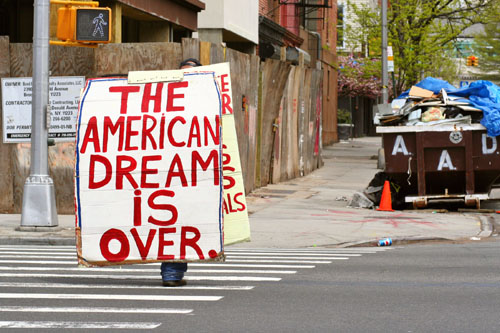
The American Dream - Fact or Fiction?
The great American Dream first expressed by James Truslow Adams in 1931, was the idea that citizens of every rank feel that they can achieve a "better, richer, and happier life." The idea of the American Dream is rooted in the second sentence of the Declaration of Independence which states that "all men are created equal" and that they are "endowed by their Creator with certain inalienable Rights" including "Life, Liberty and the pursuit of Happiness." The American Dream has been credited with helping to build a cohesive American experience, but has also been blamed for over inflated expectations.
There are a few problems with this assumption. First of all, if “all men are created equal”, then why is the American Dream exclusively American? Then there is the problem of over inflated expectations. In the late 1800’s, Horatio Alger wrote stories of fictional characters from impoverished backgrounds who, through self-reliance and hard work, were able to realize the American Dream in this land of boundless opportunity.
The idea of self-determination and rugged individualism is idealized in the Republican party. They want less government, less government regulation, and more free market economics. This is epitomized in a story floating around the internet called “A day in the Life of Joe Republican.”
Joe gets up at 6 a.m. and fills his coffeepot with water to prepare his morning coffee. The water is clean and good because some tree-hugging liberal fought for minimum water-quality standards. With his first swallow of water, he takes his daily medication. His medications are safe to take because some stupid commie liberal fought to ensure their safety and that they work as advertised.
All but $10 of his medications are paid for by his employer's medical plan because some liberal union workers fought their employers for paid medical insurance - now Joe gets it too.
He prepares his morning breakfast, bacon and eggs. Joe's bacon is safe to eat because some girly-man liberal fought for laws to regulate the meat packing industry.
In the morning shower, Joe reaches for his shampoo. His bottle is properly labeled with each ingredient and its amount in the total contents because some crybaby liberal fought for his right to know what he was putting on his body and how much it contained.
Joe dresses, walks outside and takes a deep breath. The air he breathes is clean because some environmentalist wacko liberal fought for the laws to stop industries from polluting our air. He walks on the government-provided sidewalk to subway station for his government-subsidized ride to work. It saves him considerable money in parking and transportation fees because some fancy-pants liberal fought for affordable public transportation, which gives everyone the opportunity to be a contributor.
Joe begins his work day. He has a good job with excellent pay, medical benefits, retirement, paid holidays and vacation because some lazy liberal union members fought and died for these working standards. Joe's employer pays these standards because Joe's employer doesn't want his employees to call the union.
If Joe is hurt on the job or becomes unemployed, he'll get a worker compensation or unemployment check because some stupid liberal didn't think he should lose his home because of his temporary misfortune.
It is noontime and Joe needs to make a bank deposit so he can pay some bills. Joe's deposit is federally insured by the FSLIC because some godless liberal wanted to protect Joe's money from unscrupulous bankers who ruined the banking system before the Great Depression.
Joe has to pay his Fannie Mae-underwritten mortgage and his below-market federal student loan because some elitist liberal decided that Joe and the government would be better off if he was educated and earned more money over his lifetime. Joe also forgets that his in addition to his federally subsidized student loans, he attended a state funded university.
Joe is home from work. He plans to visit his father this evening at his farm home in the country. He gets in his car for the drive. His car is among the safest in the world because some America-hating liberal fought for car safety standards to go along with the tax-payer funded roads.
He arrives at his boyhood home. His was the third generation to live in the house financed by Farmers' Home Administration because bankers didn't want to make rural loans. The house didn't have electricity until some big-government liberal stuck his nose where it didn't belong and demanded rural electrification.
He is happy to see his father, who is now retired. His father lives on Social Security and a union pension because some wine-drinking, cheese-eating liberal made sure he could take care of himself so Joe wouldn't have to.
Joe gets back in his car for the ride home, and turns on a radio talk show. The radio host keeps saying that liberals are bad and conservatives are good. He doesn't mention that the beloved Republicans have fought against every protection and benefit Joe enjoys throughout his day. Joe agrees: "We don't need those big-government liberals ruining our lives! After all, I'm a self-made man who believes everyone should take care of themselves, just like I have."
We are addicted to this rag-to-riches myth in this country. That is why we bought into the Reagan theory of “trickle down economics.” The idea that if the rich are allowed to make as much money as they can, some of it will trickle down on the rest of us as they steal into the night with their huge bags of cash. George H. W. Bush called this “voodoo economics.” We have seen the result of 30 years of Reaganomics - the rich have gotten richer, the poor have gotten poorer, and the middle class has all but vanished.
Although this economic theory has been proven wrong time and time again, people have been brainwashed into believing that the American Dream still can apply to them too. Most people outside of America don’t live their lives based on fairy tales. They live in reality, where there are only going to be a few rich people, and you are not going to be one of them. So get used to it.
The rich have gotten richer, and as a result, they have destroyed the American Dream and have sent the world economy into a tailspin that hasn’t been seen since the great depression. The rich, instead of being drawn and quartered and hung at dawn at city gates, they have gotten a big wet kiss in the form of record tax breaks from Congress, and no one has said a word. Why? Because we’re still addicted to the Horatio Alger myth, that someday, I can make it big after all. So don’t attack the rich man, because one day that rich man may be me!
Let me burst the bubble of this myth once and for all.
The Declaration of Independence says that we are "endowed by our Creator with certain inalienable Rights" including "Life, Liberty and the pursuit of Happiness." This acknowledgement of the creator’s endowment is certainly true. Not a blade of grass can move without God’s sanction. It says nothing about how each individual is self endowed with this ability.
The ancient Vedic wisdom of the Srimad-Bhagavatam clarifies this point. The 6th Canto, 12th Chapter, 13th Verse states:
“Just as a person not inclined to die must nonetheless give up his longevity, opulence, fame and everything else at the time of death, so, at the appointed time of victory, one can gain all these when the Supreme Lord awards them by His mercy.”
In the purport, Srila Prabhupada writes,
“It is not good to be falsely puffed up, saying that by one’s own effort one has become opulent, learned, beautiful and so on. All such good fortune is achieved through the mercy of the Lord. From another point of view, no one wants to die, and no one wants to be poor or ugly. Therefore, why does the living entity, against his will, receive such unwanted troubles? It is due to the mercy or chastisement of the Supreme Personality of Godhead that one gains or loses everything material. No one is independent; everyone is dependent on the mercy or chastisement of the Supreme Lord. There is a common saying in Bengal that the Lord has ten hands. This means that He has control everywhere—in the eight directions and up and down. If He wants to take everything away from us with His ten hands, we cannot protect anything with our two hands. Similarly, if He wants to bestow benedictions upon us with His ten hands, we cannot factually receive them all with our two hands; in other words, the benedictions exceed our ambitions. The conclusion is that even though we do not wish to be separated from our possessions, sometimes the Lord forcibly takes them from us; and sometimes He showers such benedictions upon us that we are unable to receive them all. Therefore either in opulence or in distress we are not independent; everything is dependent on the sweet will of the Supreme Personality of Godhead.”
The American dream is a myth in as much as it is interpreted as being achieved as a result of one’s own endeavor, and that is the status quo belief. We must debunk this myth. It is only God who can give or take away the American Dream. Man proposes, and God disposes. We can work like asses for our own sense gratification, which is all taken away at the time of death, or we can serve God, for his pleasure. If we serve God, we will be given all that we require for our maintenance, but that should not be equated with the opulence given to those who have worked for their own selfish gratification. One type of work is binding (that of the karmi, or fruitive worker), another is liberating, (that of a devotee), who can use anything in the service of God, and is not entangled in the reactions of that labor. The devotee is free from karma, and will be liberated from the hard struggle for material existence, and go back to Godhead, to be in his constitutional position, as an eternal servant of God. The karmi will continue to rot in this material world, life after life. That is not the American Dream.
There are a few problems with this assumption. First of all, if “all men are created equal”, then why is the American Dream exclusively American? Then there is the problem of over inflated expectations. In the late 1800’s, Horatio Alger wrote stories of fictional characters from impoverished backgrounds who, through self-reliance and hard work, were able to realize the American Dream in this land of boundless opportunity.
The idea of self-determination and rugged individualism is idealized in the Republican party. They want less government, less government regulation, and more free market economics. This is epitomized in a story floating around the internet called “A day in the Life of Joe Republican.”
Joe gets up at 6 a.m. and fills his coffeepot with water to prepare his morning coffee. The water is clean and good because some tree-hugging liberal fought for minimum water-quality standards. With his first swallow of water, he takes his daily medication. His medications are safe to take because some stupid commie liberal fought to ensure their safety and that they work as advertised.
All but $10 of his medications are paid for by his employer's medical plan because some liberal union workers fought their employers for paid medical insurance - now Joe gets it too.
He prepares his morning breakfast, bacon and eggs. Joe's bacon is safe to eat because some girly-man liberal fought for laws to regulate the meat packing industry.
In the morning shower, Joe reaches for his shampoo. His bottle is properly labeled with each ingredient and its amount in the total contents because some crybaby liberal fought for his right to know what he was putting on his body and how much it contained.
Joe dresses, walks outside and takes a deep breath. The air he breathes is clean because some environmentalist wacko liberal fought for the laws to stop industries from polluting our air. He walks on the government-provided sidewalk to subway station for his government-subsidized ride to work. It saves him considerable money in parking and transportation fees because some fancy-pants liberal fought for affordable public transportation, which gives everyone the opportunity to be a contributor.
Joe begins his work day. He has a good job with excellent pay, medical benefits, retirement, paid holidays and vacation because some lazy liberal union members fought and died for these working standards. Joe's employer pays these standards because Joe's employer doesn't want his employees to call the union.
If Joe is hurt on the job or becomes unemployed, he'll get a worker compensation or unemployment check because some stupid liberal didn't think he should lose his home because of his temporary misfortune.
It is noontime and Joe needs to make a bank deposit so he can pay some bills. Joe's deposit is federally insured by the FSLIC because some godless liberal wanted to protect Joe's money from unscrupulous bankers who ruined the banking system before the Great Depression.
Joe has to pay his Fannie Mae-underwritten mortgage and his below-market federal student loan because some elitist liberal decided that Joe and the government would be better off if he was educated and earned more money over his lifetime. Joe also forgets that his in addition to his federally subsidized student loans, he attended a state funded university.
Joe is home from work. He plans to visit his father this evening at his farm home in the country. He gets in his car for the drive. His car is among the safest in the world because some America-hating liberal fought for car safety standards to go along with the tax-payer funded roads.
He arrives at his boyhood home. His was the third generation to live in the house financed by Farmers' Home Administration because bankers didn't want to make rural loans. The house didn't have electricity until some big-government liberal stuck his nose where it didn't belong and demanded rural electrification.
He is happy to see his father, who is now retired. His father lives on Social Security and a union pension because some wine-drinking, cheese-eating liberal made sure he could take care of himself so Joe wouldn't have to.
Joe gets back in his car for the ride home, and turns on a radio talk show. The radio host keeps saying that liberals are bad and conservatives are good. He doesn't mention that the beloved Republicans have fought against every protection and benefit Joe enjoys throughout his day. Joe agrees: "We don't need those big-government liberals ruining our lives! After all, I'm a self-made man who believes everyone should take care of themselves, just like I have."
We are addicted to this rag-to-riches myth in this country. That is why we bought into the Reagan theory of “trickle down economics.” The idea that if the rich are allowed to make as much money as they can, some of it will trickle down on the rest of us as they steal into the night with their huge bags of cash. George H. W. Bush called this “voodoo economics.” We have seen the result of 30 years of Reaganomics - the rich have gotten richer, the poor have gotten poorer, and the middle class has all but vanished.
Although this economic theory has been proven wrong time and time again, people have been brainwashed into believing that the American Dream still can apply to them too. Most people outside of America don’t live their lives based on fairy tales. They live in reality, where there are only going to be a few rich people, and you are not going to be one of them. So get used to it.
The rich have gotten richer, and as a result, they have destroyed the American Dream and have sent the world economy into a tailspin that hasn’t been seen since the great depression. The rich, instead of being drawn and quartered and hung at dawn at city gates, they have gotten a big wet kiss in the form of record tax breaks from Congress, and no one has said a word. Why? Because we’re still addicted to the Horatio Alger myth, that someday, I can make it big after all. So don’t attack the rich man, because one day that rich man may be me!
Let me burst the bubble of this myth once and for all.
The Declaration of Independence says that we are "endowed by our Creator with certain inalienable Rights" including "Life, Liberty and the pursuit of Happiness." This acknowledgement of the creator’s endowment is certainly true. Not a blade of grass can move without God’s sanction. It says nothing about how each individual is self endowed with this ability.
The ancient Vedic wisdom of the Srimad-Bhagavatam clarifies this point. The 6th Canto, 12th Chapter, 13th Verse states:
“Just as a person not inclined to die must nonetheless give up his longevity, opulence, fame and everything else at the time of death, so, at the appointed time of victory, one can gain all these when the Supreme Lord awards them by His mercy.”
In the purport, Srila Prabhupada writes,
“It is not good to be falsely puffed up, saying that by one’s own effort one has become opulent, learned, beautiful and so on. All such good fortune is achieved through the mercy of the Lord. From another point of view, no one wants to die, and no one wants to be poor or ugly. Therefore, why does the living entity, against his will, receive such unwanted troubles? It is due to the mercy or chastisement of the Supreme Personality of Godhead that one gains or loses everything material. No one is independent; everyone is dependent on the mercy or chastisement of the Supreme Lord. There is a common saying in Bengal that the Lord has ten hands. This means that He has control everywhere—in the eight directions and up and down. If He wants to take everything away from us with His ten hands, we cannot protect anything with our two hands. Similarly, if He wants to bestow benedictions upon us with His ten hands, we cannot factually receive them all with our two hands; in other words, the benedictions exceed our ambitions. The conclusion is that even though we do not wish to be separated from our possessions, sometimes the Lord forcibly takes them from us; and sometimes He showers such benedictions upon us that we are unable to receive them all. Therefore either in opulence or in distress we are not independent; everything is dependent on the sweet will of the Supreme Personality of Godhead.”
The American dream is a myth in as much as it is interpreted as being achieved as a result of one’s own endeavor, and that is the status quo belief. We must debunk this myth. It is only God who can give or take away the American Dream. Man proposes, and God disposes. We can work like asses for our own sense gratification, which is all taken away at the time of death, or we can serve God, for his pleasure. If we serve God, we will be given all that we require for our maintenance, but that should not be equated with the opulence given to those who have worked for their own selfish gratification. One type of work is binding (that of the karmi, or fruitive worker), another is liberating, (that of a devotee), who can use anything in the service of God, and is not entangled in the reactions of that labor. The devotee is free from karma, and will be liberated from the hard struggle for material existence, and go back to Godhead, to be in his constitutional position, as an eternal servant of God. The karmi will continue to rot in this material world, life after life. That is not the American Dream.