Wednesday, February 24, 2010

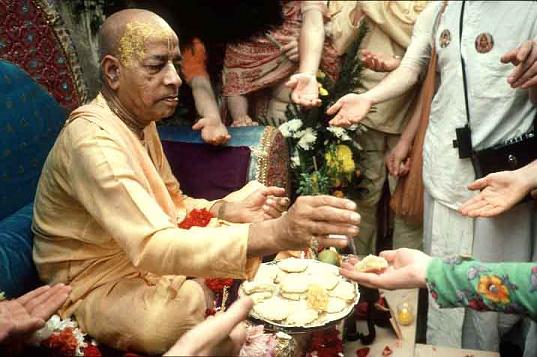
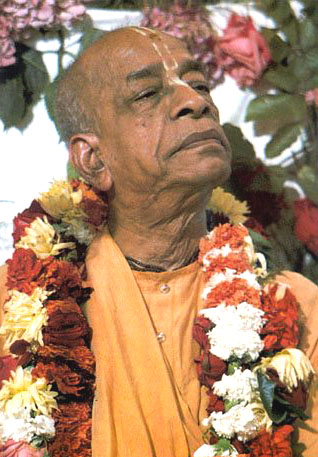
The Nectar Chronicles: Part 14

How can we ever fathom his love? He came across many seas, with so many ideas, and because of the sincerity and reality of his understanding, he saw very easily through our disqualifications and saw only the pure essence of what we could potentially give?

How can we ever fathom his vision? He, who is the greatest revolutionary, the greatest prophet, and our greatest friend, who was not beholden to cultural customs of discrimination, who out of the depths of his own heart, simply came to help us understand our own depths, and to meet the Person who lives there.

How can we ever fathom his sacrifice? It is something none of us can ever imitate. So I simply pray to you Srila Prabhupada. I pray to you to somehow fathom just a drop of your love for me, and I pray for the constant opportunity to return that love, although I will never be able to do so in full.

But you are so patient, tolerant, and accepting of any offering I may make....

***
Our material lives are simply a chain of suffering. As we mature in our spiritual lives, we come to a truth that hurts. It's a truth that with every propensity and action we have against the will and desire of Krsna, we shape another material body in this chain.

This is a truth which flies against all the reasoning of our material conditioning, which offers a stinging challenge to the enjoying spirit we hold dear. In our spiritual maturity, it is a challenge that we do not shy away from, but that we face face-to-face and give all that we can to overcome.

The art of punya-karma, the art of devotional service, is the everyday miracle of courage and strength that gives us the ability to overcome this challenge. Its main facet and potency comes through our hearing the words of Krsna and His devotees, which produce three effects: We develop actual knowledge, we develop actual renunciation, and we develop actual immunity from the effects of our sinful life.

This is a most personal development of realizations and experiences, buoyed by the most personal of exchanges, between ourselves and the Lord. Prabhupada writes in his purport to Srimad Bhagavatam 1.2.17:

"The Lord is reciprocally respondent to His devotees. When He sees that a devotee is completely sincere in getting admittance to the transcendental service of the Lord and has thus become eager to hear about Him, the Lord acts from within the devotee in such a way that the devotee may easily go back to Him.

The Lord is more anxious to take us back into His kingdom than we can desire. Most of us do not desire at all to go back to Godhead. Only a very few men want to go back to Godhead. But anyone who desires to go back to Godhead, Sri Krsna helps in all respects."


This is one of the main barometers of our spiritual progress. How much are we actually feeling this personal reciprocation from Krsna? How much do we realize that He is a Person, our Best Friend, and how much do we understand his helping presence in our lives?

Two inches of rope. His mercy and our effort. One of the most fundamental levels, yet of course one of the most difficult, is to give up our gross sinful habits. Prabhupada knew very acutely that the young disciples in front of him in the courtyard of the samadhi of Rupa Goswami on this evening were walking a tightrope, that maya's grip was still very much imperative.

Therefore he implored:

"Once we take to Krsna consciousness, we should stop the pillars of sinful activities. Whatever we did in our past life, that is excused, but if we take to Krsna consciousness, and if we go on with our sinful activities, that will not help us. Just like the same fire: you take the fuel and add to the fire, it will burn into ashes. But, at the same time, if you pour some water also, then it will be useless. Similarly, our past sinful activities, that can be burned into ashes provided we don't add any more."

It's easy to see on a somber evening in Manhattan, amidst imposing facades of concrete and poor, lost souls yelling at themselves and to no one in particular, that this material world is place of the most heavy darkness.

Prabhupada stands before us, beckoning, for us to turn to the light of our original nature, our original connection. This is a light which illuminates our whole being, and again, this is a great challenge, for in that illumination we see all that is impure, all that is false, all that we cling to with hopeless fervor.

But in turning towards that brightest of lights, we get a chance to slay our greatest enemy. Prabhupada reveals:

"And this ignorance is our greatest enemy. The human form of life is meant for acquiring knowledge, not to keep one in ignorance. Tamasi ma jyotir gamah. That is the Vedic injunction. "Don't keep yourself in darkness," darkness of ignorance. But jyotir gamah: "Go to the light." That is the Vedic injunction."

Krsna is the very source of this illuminated knowledge, leading us to His most personal loving exchange. This knowledge cannot come, no matter how hard we try, from our own imperfect senses, and from our own imperfect extensions of those senses, namely our earthbound philosophies and theories, nor from our expensive telescopes and microscopes.

Prabhupada reasons:

"A human being cannot give us any perfect knowledge. Therefore all the scientists' statements, all the philosophers' statements, they are simply theories; they are not fact. Because the knowledge is not perfect. Perfect knowledge can be had from one who is not defective. Defective means generally a conditioned soul has four defects: he commits mistake, he is illusioned, he has got a cheating propensity, and his senses are imperfect.

The senses, we are acquiring knowledge through our senses, and if our senses are imperfect, how we can acquire perfect knowledge? Just like we are trying to see the planetary system through microscope or binocular, telescope, but the telescope machine is manufactured by a person who is, whose senses are defective. So through the telescope, how you can have perfect knowledge?"


We want to perfect our pesky knowledge faculties, which so easily lead us astray down the highways of meaningless. When we link ourselves up to the parampara, in a heart-filled connection which one can even experience through this keyboard, through this hyperspace, we find the natural way.

Prabhupada defines this connection as such:

"One has to accept a guru, a spiritual master, who has received knowledge from another perfect spiritual master. Just like Krsna is the origin, perfect spiritual master, guru. So Krsna, what Krsna said, was realized by Arjuna, directly. Therefore if we receive knowledge from Arjuna or his disciplic succession, then our knowledge is perfect. Krsna..., Arjuna accepted Krsna as the Supreme Brahman: param brahma param dhama pavitram paramam bhavan [Bg. 10.12].

So if we accept the version of Arjuna, that Krsna is Param Brahman, He's the Supreme Person, He's the origin of everything, then our knowledge is perfect. I may be imperfect, but because I receive knowledge from a perfect person, my knowledge is perfect. This is called parampara system."


This natural way helps us to finally and forever give up our God-project, to cure ourselves of this perpetual fever that robs of the birthright of our own vitality. Prabhupada says:

"Liberated means, as I have several times explained, to be situated in his original position. Just like a, a person gets fever. When his fever is subsided, he's liberated, he's called liberated from the fever. Similarly, when we have perfect knowledge... What is that perfect knowledge? The perfect knowledge: to understand that "I am eternal servant of Krsna." This is perfect knowledge. This is perfect knowledge. Jivera svarupa haya nityera krsnera dasa [Cc. Madhya 20.108]. One has to understand this fact, that "I am not Krsna. I am not like Krsna. I am not equal to Krsna. I cannot become Krsna. I am Krsna's eternal servant."

Our fidelity and chastity to the parampara is also an essential element. In this, we follow the very lotus footprints of Krsna Himself, for as Prabhupada reveals, He also never made it a point to stray from the sastra:

"They are thinking if they can manufacture some new line, adding with Hare Krsna, then he becomes particularly noted. But he spoils the whole thing. That is the... He does not make any new thing. The new thing he does, he spoils the whole thing. So Caitanya Mahaprabhu never did so, although He's Krsna Himself. He stuck to the point of sastra.

Krsna, He is the Supreme Personality of Godhead.
He also indicates: yah sastra- vidhim utsrjya vartate kama-karatah na siddhim savapnoti [Bg. 16.23]. He indicates that nobody can give up the injunction of the sastra. Brahma-sutra-padais caiva hetumadbhir viniscitaih [Bg. 13.5]. Krsna says. He can give. Whatever He says, that is sastra, that is Veda. But still, He gives reference to the sastra."

***
We cannot understand the true meaning of the word liberal until we understand Prabhupada's own liberal vision, which has given each and every one of us a chance to understand love of God.

The most degraded of backgrounds is no disqualification. As we stand like Jagai and Madhai before the Lord, Prabhupada, in the exact mood of Lord Nityananda, begs for us to be given a chance, to show our true colors. He says this evening in Vrndavana:

"In these parts of the world, the Koreans, the Philippines, even the Chinese, some of the Japanese, they're dog-eaters. But even though they are dog-eaters, they attended the meeting and chanted with us so nicely, better than a so-called Vaisnava in India. Yes. They were so nice. It is practically seen. So that is also stated in the, confirmed in the Bhagavad-gita. Svado 'pi sadyah savanaya kalpate.

If one dog-eater, a person born in the family of dog-eaters... Because the dog-eaters are considered lowest of the human kind, candala, sva-paca. In many places it is said. Aho bata svapaco 'pi gariyan yaj-jihvagre nama tubhyam. Sva- paca. Svapaca means dog-eaters. They also become glorious provided they chant offenselessly the Hare Krsna mantra."


Who can fathom his liberal mercy? Let us all pray to Prabhupada to give our whole lives to simply return his favor upon us.

Thursday, February 18, 2010

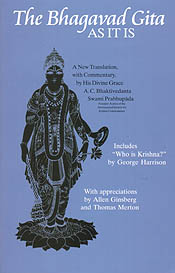
Merton's Gita intro

Christian scholar, teacher, monk, and mystic Thomas Merton's introduction to original Macmillan printing of Srila Prabhupada's Bhagavad-Gita As It Is,

The word Gita means "Song." Just as in the Bible the Song of Solomon has traditionally been known as "The Song of Songs" because it was interpreted to symbolize the ultimate union of Israel with God (in terms of human married love), so The Bhagavad Gita is, for Hinduism, the great and unsurpassed Song that finds the secret of human life in the unquestioning surrender to and awareness of Krishna.

While The Vedas provide Hinduism with its basic ideas of cult and sacrifice and The Upanishads develop its metaphysic of contemplation, The Bhagavad Gita can be seen as the great treatise on the "Active Life." But it is really something more, for it tends to fuse worship, action and contemplation in a fulfillment of daily duty which transcends all three by virtue of a higher consciousness: a consciousness of acting passively, of being an obedient instrument of a transcendent will.

The Vedas, The Upanishads, and The Gita can be seen as the main literary supports for the great religious civilization of India, the oldest surviving culture in the world. The fact that The Gita remains utterly vital today can be judged by the way such great reformers as Mohandas Gandhi and Vinoba Bhave both spontaneously based their lives and actions on it, and indeed commented on it in detail for their disciples. The present translation and commentary is another manifestation of the permanent living importance of The Gita.

Swami Bhaktivedanta brings to the West a salutary reminder that our highly activistic and one-sided culture is faced with a crisis that may end in self-destruction because it lacks the inner depth of an authentic metaphysical consciousness. Without such depth, our moral and political protestations are just so much verbiage. If, in the West, God can no longer be experienced as other than "dead," it is because of an inner split and self-alienation which have characterized the Western mind in its single-minded dedication to only half of life: that which is exterior, objective, and quantitative.

The "death of God" and the consequent death of genuine moral sense, respect for life, for humanity, for value, has expressed the death of an inner subjective quality of life: a quality which in the traditional religions was experienced in terms of God-consciousness. Not concentration on an idea or concept of God, still less on an image of God, but a sense of presence, of an ultimate ground of reality and meaning, from which life and love could spontaneously flower.

Realization of the Supreme "Player" whose "Play" (Lila) is manifested in the million-formed, inexhaustible richness of beings and events, is what gives us the key to the meaning of life. Once we live in awareness of the cosmic dance and move in time with the Dancer, our life attains its true dimension.

It is at once more serious and less serious than the life of one who does not sense this inner cosmic dynamism. To live without this illuminated consciousness is to live as a beast of burden, carrying one's life with tragic seriousness as a huge, incomprehensible weight (see Camus' interpretation of the Myth of Sisyphus). The weight of the burden is the seriousness with which one takes one's own individual and separate self. To live with the true consciousness of life centered in Another is to lose one's self-important seriousness and thus to live life as "play" in union with a Cosmic Player.

It is He alone that one takes seriously. But to take Him seriously is to find joy and spontaneity in everything, for everything is gift and grace. In other words, to live selfishly is to bear life as an intolerable burden. To live selflessly is to live in joy, realizing by experience that life itself is love and gift. To be a lover and a giver is to be a channel through which the Supreme Giver manifests His love in the world.

But The Gita presents a problem to some who read it in the present context of violence and war which mark the crisis of the West. The Gita appears to accept and to justify war. Arjuna is exhorted to submit his will to Krishna by going to war against his enemies, who are also his own kin, because war is his duty as a Prince and warrior. Here we are uneasily reminded of the fact that in Hinduism as well as in Judaism, Islam, and Christianity, there is a concept of a "Holy War" which is "willed by God" and we are furthermore reminded of the fact that, historically, this concept has been secularized and inflated beyond measure.

It has now "escalated" to the point where slaughter, violence, revolution, the annihilation of enemies, the extermination of entire populations and even genocide have become a way of life. There is hardly a nation on earth today that is not to some extent committed to a philosophy or to a mystique of violence. One way or other, whether on the left or on the right, whether in defense of a bloated establishment or of an improvised guerrilla government in the jungle, whether in terms of a police state or in terms of a ghetto revolution, the human race is polarizing itself into camps armed with everything from Molotov cocktails to the most sophisticated technological instruments of death.

At such a time, the doctrine that "war is the will of God" can be disastrous if it is not handled with extreme care. For everyone seems in practice to be thinking along some such lines, with the exception of a few sensitive and well-meaning souls (mostly the kind of people who will read this book).

The Gita is not a justification of war, nor does it propound a war-making mystique. War is accepted in the context of a particular kind of ancient culture in which it could be and was subject to all kinds of limitations. (It is instructive to compare the severe religious limitations on war in the Christian Middle Ages with the subsequent development of war by nation states in modern times-backed of course by the religious establishment. )

Arjuna has an instinctive repugnance for war, and that is the chief reason why war is chosen as the example of the most repellent kind of duty. The Gita is saying that even in what appears to be most "unspiritual" one can act with pure intentions and thus be guided by Krishna consciousness. This consciousness itself will impose the most strict limitations on one's use of violence because that use will not be directed by one's own selfish interests, still less by cruelty, sadism, and mere blood lust.

The discoveries of Freud and others in modern times have, of course, alerted us to the fact that there are certain imperatives of culture and of conscience which appear pure on the surface and are in fact bestial in their roots. The greatest inhumanities have been perpetrated in the name of "humanity," "civilization," "progress," "freedom," "my country," and of course "God."

This reminds us that in the cultivation of an inner spiritual consciousness there is a perpetual danger of self-deception, narcissism, self-righteous evasion of truth. In other words the standard temptation of religious and spiritually minded people is to cultivate an inner sense of rightness or of peace, and make this subjective feeling the final test of everything. As long as this feeling of rightness remains with them, they will do anything under the sun. But this inner feeling (as Auschwitz and the Eichmann case have shown) can coexist with the ultimate in human corruption.

The hazard of the spiritual quest is of course that its genuineness cannot be left to our own isolated subjective judgment alone. The fact that I am turned on doesn't prove anything whatever. (Nor does the fact that I am turned off.) We do not simply create our own lives on our own terms. Any attempt to do so is ultimately an affirmation of our individual self as ultimate and supreme. This is a self-idolatry which is diametrically opposed to "Krishna consciousness" or to any other authentic form of religious or metaphysical consciousness.

The Gita sees that the basic problem of man is his endemic refusal to live by a will other than his own. For in striving to live entirely by his own individual will, instead of becoming free, man is enslaved by forces even more exterior and more delusory than his own transient fancies.

He projects himself out of the present into the future. He tries to make for himself a future that accords with his own fantasy, and thereby escape from a present reality which he does not fully accept. And yet, when he moves into the future he wanted to create for himself, it becomes a present that is once again repugnant to him. And yet this is precisely what he has "made" for himself-it is his own karma.

In accepting the present in all its reality as something to be dealt with precisely as it is, man comes to grips at once with his karma and with a providential will which, ultimately, is more his own than what he currently experiences, on a superficial level, as "his own will." It is in surrendering a false and illusory liberty on the superficial level that man unites himself with the inner ground of reality and freedom in himself which is the will of God, of Krishna, of Providence, of Tao.

These concepts do not all exactly coincide, but they have much in common. It is by remaining open to an infinite number of unexpected possibilities which transcend his own imagination and capacity to plan that man really fulfills his own need for freedom. The Gita, like the Gospels, teaches us to live in awareness of an inner truth that exceeds the grasp of our thought and cannot be subject to our own control. In following mere appetite for power, we are slaves of our own appetite. In obedience to that inner truth we are at last free.

Sunday, January 24, 2010

Thoughts For The New Year by Radhanath Swami

By Radhanath Swami

www.radhanathswami.com
www.radhanathswamiweekly.com
www.radhanathswamionline.com
Radhanath Swami's Facebook page
Radhanath Swami's MySpace page
Radhanath Swami's Twitter page
Radhanath Swami's YouTube page

A Talk by Radhanath Swami
January 2, 2010 Bhaktivedanta Manor England

When we asked His Holiness Giriraj Swami what tonight’s topic would be, he said, “I will lead kirtana and see what emerges from my heart.” I will try to speak a few words on some of the primary themes of His Holiness Giriraj Maharaja’s beautiful dissertation.

Maharaja was stressing how much suffering comes to us in this world when we individually and collectively forget the purpose of life. Srila Bhaktisiddhanta Sarasvati Thakura would often say, and Srila Prabhupada would often quote him, that the only real problem in this world is a lack of Krsna consciousness. It is actually very simple. Krsna consciousness is so simple, yet we take these simple things for granted because we’ve heard them for so many years, and we look for more complicated ideas to satisfy our minds. Mostly we become distracted and complicated-minded by the complications of material nature. Krsna consciousness means to understand, “I am not this body; I am an eternal soul. Na jayate mriyate va kadacin. I am not subject to birth. I am not subject to death. I am the driver within this vehicle of a body and mind.”

And what is the nature of that atma, or soul? Mamaivamso jiva-loke jiva-bhutah sanatanah–we are part and parcel of Krsna, the Supreme Soul. And the nature of the Absolute Truth, Krsna, as the name Krsna denotes, is all-attractive, the supreme reservoir of all pleasure. And jivera ’svarupa’ haya-krsnera ‘nitya-dasa’–as parts of God, our nature is that we are the servants of God. And because God is the supreme reservoir of all pleasure, the all-beautiful, all-knowledgeable, all-merciful reservoir of all love, the greatest pleasure in life is simply to make that connection.

How to make that connection? It is very simple. As Giriraj Maharaja explained, just put Krsna, God, in the center. Many of you have heard the analogy given from Srimad-Bhagavatam that if you water the root of the tree, all the parts of the tree–the leaves, the flower, the twigs, and the bark–will all be nourished. If simply you understand this, you will be completely liberated from all sufferings and will experience the highest ecstasies of divine love. That’s really all it takes. Just understand that–not theoretically, but really. It is that simple.

Sri Caitanya Mahaprabhu made it so simple, how to water the root of the tree. Just be conscious of Krsna–by purifying our heart through chanting the holy names and always being in the mood of a servant. In other words, by giving up our selfishness. It’s that easy. If that’s all you know and you actually understand it, you will attain the ultimate culmination of all philosophies, all religions, and all the scriptures in all the worlds.

Kapiladeva describes the Vedic literatures, which comprise thousands of volumes. Just one volume alone, Mahabharata, is a hundred thousand verses. And there are so many Vedic literatures. And not only Vedic literatures. He is talking about all the spiritual and religious literatures throughout the world. They are all meant to bring us to this very simple conclusion: to never forget Krsna and always remember Krsna in that spirit of a humble servant, keeping Krsna in the center. We hear it, we speak it, but how much do we really make it the priority of our life? All the problems of our society, the spiritual society in which we live, and all the difficulties of the society of the world are due to our missing this point. As Maharaja said, our tendency is to put ourselves in the center. And as soon as we become selfish, we are subjected to the endless complications of material existence. And how to deal with that? The complications are endless.

Sri Prahlada Maharaja, a five-year-old child, spoke eloquent philosophy, but he was a simple boy who had simple conclusions. He looked around at the whole world, and he looked at his father, Hiranyakasipu, who was a really complicated person [laughter]. His father was a brahmana and the son of a rsi, and yet he was really confused. Prahlada said that when we lose reference to the focus of the goal of life, then every time we try to solve a problem, our solution becomes a bigger problem than the original problem. And isn’t that what is happening in the world? We want more convenience, so we create technology, but we forget the basic premise, and when technology is developed on the basis of selfishness and greed, whether individual or collective, it is going to create bigger problems than the original problem.

And then we have religion. Religion is also supposed to solve problems. But when we interpret our religion in a selfish way, when we interpret it such that “I am in the center,” or “We are in the center,” instead of being compassionate beings, we become egoistic, and then the religion becomes a bigger problem than we had without the religion–or whatever the solution: science or technology or philosophy.

We were recently discussing philosophy, how so many of the most profoundly brilliant philosophers, toward the end of their lives, went mad. They became either suicidal or really, really crazy, because they were trying with their minds to understand what is beyond the mind. Ordinary, selfish, materialistic people just try to gratify their desire for prestige or gratify their senses, but philosophers try to make sense of it all. In the process, they see how futile the endeavor for material enjoyment is, how futile the endeavor for prestige and pride and acquirement of property is. They want something more. They want to make sense of it. But the nature of the world, Krsna says, is endlessly mutable, endlessly complicated, unless you come back to the very simple premises of why this world exists, who we are, and what we’re supposed to do. When we keep trying to solve problems on the basis of the intellect–they are so vast and our intellect is so tiny in comparison–we get short circuited. We become hopeless, because what we’re looking for is not a thing of the intellect.

The real problems of the world, and the solutions to the problems, are revealed by the grace of God to the simple heart. Caitanya Mahaprabhu stressed how we always have to be simple in heart. Even if we are profound philosophers, we have to be very simple in heart. What does it mean to be simple in heart? It means not to be complicated [laughter], because everything is so simple: “I am an eternal soul, I am part of Krsna, and I am supposed to love Krsna.” And this is the way to love Krsna: to chant and to serve. It is so easy.

Someone may say, “The gopis were not great philosophers.” But they were the ultimate greatest philosophers, because in their simplicity they realized the conclusion of all philosophy and they were happy.

So, as soon as we living entities, as Giriraj Maharaja was saying, become selfish, want to put ourselves in the center–want to get credit, want to be the proprietor, want to be the enjoyer, either mentally or physically-we cast ourselves into a vast ocean of complications. But if we get in the habit, as Maharaja said, of practicing what sadhana-bhakti really is, which is about putting into practice these simple basic principles–that our real enjoyment is in serving, not in acquiring, that our real enjoyment is in putting the pleasure of the Supreme Lord, Sri Krsna, in the center of our lives–then everything will become very simple. Every problem can be so effectively addressed if we just keep this siddhanta as our focus. Whether it is a relationship problem, an environmental problem, an economic problem, or a health problem or domestic problem or any other type of problem, when we try to resolve it on the basis of the mundane level of the problem, even if we find a solution, it will eventually exacerbate the problem.

There are so many problems of war in this world. As Prabhupada said, they made a League of Nations after World War One, and they made a United Nations after World War Two. But has there ever been a time without wars? Prabhupada said that the pinprick in the whole system is so simple: We are forgetting that Krsna is in the center.

And even among devotees, due to material nature, because we are living in material existence, there is the propensity to argue, to disagree, to fight, to form positions and defend our positions, to criticize, to find fault, to undermine people. This has been going on in every religion, including our own, throughout history as well as today. These problems arise and are perpetuated when there is selfishness. But if we can just maintain our focus on keeping Krsna at the center, this propensity will naturally diminish. And this is the way Prabhupada was. Everything he said, the way he dealt with every issue, came from being totally focused on the basic principles. If we water the root of the tree, all the parts of the tree will be satisfied. If we make Krsna happy, everything will be nice. Individually, when we try to make Krsna happy, in our own hearts we find something very deep, but to the degree we have our selfish egos, within our own minds there are so many complications and confusions, and it is exacerbated by things that happen outside of us.

Whatever the situation, we should think, “How can I best please Krsna? How can I best please guru? How can I best please the Vaisnavas? How can I best be a compassionate instrument for all living beings?” If that’s really our motivation and we keep that focus, then in our own personal lives big problems become insignificant.

And amongst each other, there are so many disagreements. But almost all disagreements arise because we are not focused on that central point. Krsna wants harmony among His devotees. Even if there are serious disagreements, they should all be harmonized. They should all create an increase of love and trust, and they will if we are focused on the simple basis. But that’s how maya traps us–the illusory energy takes our focus away from the siddhanta, the essence, the simplicity of the treasure we’ve been given, and gets us all caught up in our own passions and our own anxieties and frustrations and essentially our selfishness in all the differences we have with others. We become enemies. Have you ever met two devotees following Prabhupada who are enemies? How is that possible? It is actually not possible. If we are actually following Prabhupada, we won’t be enemies. We’ll be able to harmonize our differences on the basis of the ultimate good.

So harmonizing the temporary phenomena of this world, of what comes into our lives, with the higher principle of bhakti–watering the root of the tree–is the only solution. In this year of 2010 the world is really a mess. Economically it is a mess. There are wars and potential wars in so many places. There are persecutions and harassments and genocides. There are ecological disasters growing worse and worse. So many problems. We may boast, “Look at our progress. We have cured tuberculosis. We have cured smallpox.” That’s great, that’s wonderful, but practically one third of people are predicted to die of cancer. And what about depression and heart disease? You cure one disease, but another one causes just as much or more suffering and death. Unless we really focus on the center, we are not solving the problem of suffering. We are not solving the problem of finding real happiness.

Prabhupada, on behalf of Sri Caitanya Mahaprabhu, envisioned our society to be a place of shelter from all this selfish egoism. Many people who have come to this path, especially in the Western world, had been frustrated with the superficialities and hypocrisies and all the fighting and judgmentalism in the way the conventional religions of their places were being practiced. It is not what the religions’ scriptures say but the way they are practiced. And then when people hear Prabhupada speak, it makes so much sense. It is so real. And people in the world today, as much as or more than at any other time in modern history, really need shelter. There are so many problems. And with all of these nuclear bombs–there are literally tens and thousands of nuclear bombs in storehouses–we are just one button away from mass destruction. People are pretty crazy, whatever nation they belong to. You get fearful when you board a plane. It is very difficult.

So, Prabhupada and our acaryas envisioned that our society would give shelter to people, but just because we are the Hare Krsna movement, we are not going to give shelter. We have to be Hare Krsna devotees to give shelter to people. And what does it mean to be a Hare Krsna devotee? It means to keep the total focus in our lives on the simple essence of watering the root of the tree. Not being selfish. Being compassionate.

I am very jealous of that lady bug that was on Giriraj Swami’s finger–or maybe she was crawling on his lotus feet and eating the dust. [laughter] He was glancing on that lady bug with such compassion, with such concern, with such love, and wanting to give it Krsna–how fortunate. That lady bug may be reborn as one of the children of the congregation of Bhaktivedanta Manor. [laughter] Such is the power of the prayer of a Vaisnava. So if we can just think about each other the way Giriraj Swami thought of that insect and just try to give each other Krsna, just try to share Krsna with each other, it is so beautiful. Why do we get caught up in all this stuff? We deal with the stuff, but we should always try to share Krsna with each other. If we never, never move an inch from that platform, we will become divinely empowered.

We are coming into this new decade, 2010. Let us try to re-habituate ourselves to have simple hearts and resolve the complications of the world with the simple solutions and never leave that. Caitanya Mahaprabhu’s first instruction to Sanatana Gosvami–out of volumes of instructions, the first was the seed that actually contained everything, and all the other hundreds of pages of instructions just explained this simple instruction–was jivera ’svarupa’ haya-krsnera ‘nitya-dasa,’ that every living being is the eternal servant of Krsna. Krsna is the enjoyer. Our enjoyment is in serving, in pleasing. Everything is there. And Mahaprabhu elaborated, gopi-bhartuh pada-kamalayor dasa-dasa-dasanudasah. What does it mean to be the servant of Krsna? It means to be the servant of the servant of the servant of the servant and feel oneself anu, very grateful. If you feel yourself qualified for something, you are not grateful. If you feel yourself unqualified, you are really grateful. So when you are humble you can be grateful, and when you become grateful you become full of greatness, because you become full of Krsna, who is great.

It is so simple. And this was Giriraj Maharaja’s explanation of how we should remain in this simple, humble frame of mind of just being a servant and chanting the holy names: Hare Krsna, Hare Krsna, Krsna Krsna, Hare Hare/ Hare Rama, Hare Rama, Rama Rama, Hare Hare.

Thank you very much.

Sunday, December 27, 2009

The Nectar Chronicles: Part 13

Inspired by the "Nectar of Devotion" lecture series given by His Divine Grace Srila Prabhupada from October 20-November 13, 1972 at the Radha-Damodara Temple in Vrndavana, India

All of these lectures are available for download at ISKCON Desire Tree.


11-4-72

The daze and haze of our material existence lend itself quite nicely to the existential disconnection that hovers at the edges of our lives and duties. When we dig deep, and for most, this digging deep is a "luxury" not easily chosen, we find a well of distress, miscommunication, and misunderstanding at the core of our existence.

No wonder everything gets bigger, brighter, flashier, and louder. Better to keep those voices in our heads from barking too loud.

There are plenty of "prescription remedies" to give us a mere semblance of relief from material distress, but if we have come into the association of the devotees, and we begin to practice devotional service, we can begin to understand it's a reality that bears no inebriation or illusion. In fact, it actually does what it advertises.

As a matter of fact, it's the real escape for all of us who have had the grace and the fortune to realize that running away from the material world is not a sign of laziness or indolence, but of enlightenment.

It's not that devotees don't work hard. Right? Devotees work very hard. I don't have to tell you that. Our own lives and the history of our society, from Prabhupada on down, are glittered with the pastimes and experiences of those who pushed well beyond their own limits and boundaries, like a Trane solo in his final years, into something more transcendent.

So we aren't lazy, and the trick to avoid this laziness is to take our vocation, take our effort, and fully link it up to the will of the Lord. This includes maybe even our temper, as Prabhupada of course relates our famous example of Hanuman burning down Lanks for the favor of Lord Rama.

So, it is our physical and mental effort, this dovetailing and engagement, which helps us to find relief from material distress, or relief from the ultimate existential angst, which is the scourge of contemporary philosophical and practical outlook.

This dovetailing cannot be left up to the whimsical dictates of our own mind alone, rotted out and molded up by the mundane conditioning of our lifetimes of wanderings. We must be guided by guru, sadhu and sastra. Prabhupada concurs:

"So by any action, if it is dovetailed for the satisfaction of Krsna, that is devotional service, and one can attract Krsna, attention of Krsna. Attention of Krsna can be attracted by pure devotional service, without any personal motive. If it is... And that motive, that order, is received through the disciplic succession of the spiritual master, how Krsna will be pleased. In the present condition, we do not know how Krsna will be pleased, but we know from the sastras... We can know also from the direction of the spiritual master how Krsna will be pleased. Yasya prasadad bhagavat-prasadah **. So Visvanatha Cakravarti Thakura says you have to follow the direction of the spiritual master. He's guiding as a leader. And if he's pleased, that means Krsna is pleased. Yasya prasadad bhagavat-prasadah **"

Then we will understand how to please Krsna, which is the secret of life, and we will be able to approach our lives and duties with less and less tinges of our own personal, selfish motives, which block the flow of Krsna's love in our being like a hearty beaver-built dam.

It is this flood of His love which overwhelms all of our negative propensities, and even overwhelms all the unknowing sinful reactions we take on just being in this material world.

It's not just the negative. Even the unknowing material piety we may commit isn't held against us if we are committing to the life of a bhakta. Prabhupada relates:

"So how to save? That is replied in the Bhagavad-gita: yajnarthe karma anyatra loko 'yam karma-bandhanah [Bg. 3.9]. If you do not act, or if you do not engage yourself in Krsna consciousness business, then you are becoming implicated with so many sinful activities. That is sure. Therefore one has to take to Krsna consciousness without fail. Otherwise he'll be entangled, karma-bandhanah. Even if he's doing pious activities, he's becoming entangled in karma-bandhanah, in bondage. He has to take birth. Pious activities means he has to take birth in nice family, rich family. That is also bandhana. He has to enter into the womb of the mother and live there for ten months, in compact, air-tight, compact bag. That is not very good living condition. But we forget all these things, neither we do not care for all these things. But actually fact is, knowingly or unknowingly, we are becoming implicated."

Or as he also states it very succinctly:

"Everyone is being caught up by the action and reaction of karma, but a devotee is protected from the action and reaction of karma. Karmani nirdahati kintu ca bhakti-bhajam [Bs. 5.54]. So a devotee, a Krsna conscious person, remains free always, provided he's fully engaged in Krsna conscious activities for pleasing the Supreme Personality of Godhead. "

It's these karmic whirlwinds which give none of us any stability in his material world. Like a relentless tornado on country plains, these winds can, in a split second, send our plans into pieces over things we have done way back even in lives previous.

And for those not aware of this essential law of the material universe, it is not that ignorance is bliss. Karma is fundamental. It is the engine of the endless chains of actions and reactions. It is the snake eating its own tail, the wheel of samsara.

We want off this ride, and by learning to love and please Krsna through His devotees, we get the ticket out, or we get the monkey off of our back, for lack of a better term.

Because, as Prabhupada relates, Krsna Himself takes charge of us:

"If you take to Krsna consciousness without any motive, sincerely, then your position is secured. Krsna takes charge of you. Kaunteya pratijanihi na me bhaktah pranasyati [Bg. 9.31]. His devotee will never be vanquished. Just like Arjuna. Arjuna was considering how he could kill his kinsmen, his familymen, his nephew, his brother, his grandfather, on the other side. Actually, this killing business is not very good. It is sinful. But the same thing he committed after understanding Bhagavad-gita. He agreed: karisye vacanam tava [Bg. 18.73]. "Yes, I shall fight."

Our own sincere effort, and the shelter of determination that are the devotees, are also our "safety position":

"We should be very careful that we may not create another material body. And what is that safety position? Krsna says, janma karma me divyam yo janati tattvatah [Bg. 4.9]. If you simply try to understand Krsna, how Krsna takes His birth, how He becomes the son of Devaki, son of Nanda Maharaja, how He becomes the son of Yasoda, these things, if we study, if we try to understand Krsna, if we don't accept Krsna as ordinary man -- avajanati mam mudha -- then, in this way, if we understand the science of Krsna, yei krsna-tattva-vetta sei guru haya [Cc. Madhya 8.128], if one understands the science of Krsna, he is spiritual master."
Prabhupada's points here are powerful and profound. He commands us not to shape another body to take birth in by our misguided actions, and he tells us to avoid a relapse into the material "disease" we are trying to leave behind.

"If you do not relapse the disease, then you are nice. Similarly, to keep in Krsna consciousness means you are not diseased condition, but do not allow the disease to relapse. That means do not deviate from the devotional service. Mam ca avyabhicarena bhakti-yogena yah sevate. Avyabhicarini. Don't misuse the devotional service. Then you are all right. Sa gunan samatityaitan brahma-bhuyaya kalpate [Bg. 14.26]. Then you keep yourself always in transcendental position, brahma-bhutah position. And then from brahma-bhutah position, you can elevate yourself to the para bhakti, spontaneous. Para bhakti means spontaneously, spontaneous devotional service. Automatically, you will be loving Krsna."

As well, Prabhupada implores us to try and move beyond the platform of kanistha realization, which to me, as I see this specific struggle in my own life, means to learn and love and communicate with others in our lives, developing our relationships with actual, personal devotees who are pushing and prodding us to something more, to something higher. Prabhupada says:

"We can expect after executing devotional service as a madhyama- adhikari. Then we can be promoted. But if we keep ourself simply on the lower stage of devotional service, then there is chance of falling down. Sa bhaktah prakrtah smrtah. Simply... Just like, generally, they keep in the kanistha-adhikari stage. Of course, there is no loss. In any adhikara, in any position, you are benefited because you have taken to devotional service. But our attempt should be from kanistha- adhikara to madhyama-adhikara. Madhyama-adhikara means preacher. Unless one comes to the madhyama-adhikara, he cannot preach."

To get real relief from our material distress means so many things, but we can distill to one nectarine simplicity: we have to open our heart (in our relationships with each other as devotees) to allow Krsna to take charge of our lives, and then we will have no fear and no doubt about who we are and what we must do. Prabhupada concludes:

"So we have to take to devotional service. Then we shall understand Krsna. Krsna will reveal. If you are engaged in Krsna's service constantly, tesam satata-yuktanam bhajatam priti-purvakam [Bg. 10.10]. If you have devoted, heart and soul, for service of Krsna, then Krsna is within your self. He'll give you intelligence. Buddhi-yogam dadami tam. He'll give you intelligence. He'll purify your heart. He'll purify your position. "

Sunday, December 20, 2009

A Mistaken Advancement In Civilization

Srila Prabhupada remarks:

According to the laws of nature, when one is extremely opulent one becomes degraded, and this is true both individually and collectively. The demigods are situated in the mode of goodness, but sometimes even one who is situated in such an exalted position as King
Indra, the king of all the demigods, falls down because of material opulence. We are now actually seeing this in America.

The entire American nation has tried to advance in material opulence without striving to produce ideal human beings. The result is that Americans are now regretting the wholesale criminality of American society and are wondering how America has become so lawless and unmanageable. As stated in
Śrīmad-Bhāgavatam (7.5.31), na te viduḥ svārtha-gatiḿ hi viṣṇum: persons who are unenlightened do not know the aim of life, which is to return home, back to Godhead. Therefore, both individually and collectively, they try to enjoy so-called material comforts, and they become addicted to wine and women.

The men produced in such a society are less than fourth class. They are the unwanted population known as
varṇa-sańkara, and as stated in Bhagavad-gītā, an increase of varṇa-sańkara population creates a hellish society. This is the society in which Americans now find themselves.

Fortunately, however, the Hare Kṛṣṇa movement has come to America, and many fortunate young men are giving serious attention to this movement, which is creating ideal men of first-class character, men who completely refrain from meat-eating, illicit sex, intoxication and gambling. If the American people are serious about curbing the degraded criminal life of their nation, they must take to the Kṛṣṇa consciousness movement and try to create the kind of human society advised in Bhagavad-gītā (cātur-varṇyaḿ mayā sṛṣṭaḿ guṇa-karma-vibhāgaśaḥ [Bg. 4.13]).

They must divide their society into first-class men, second-class men, third-class men and fourth-class men. Since they are now creating only men who are less than fourth class, how can they avoid the dangers of a criminal society? Long, long ago, Lord Indra regretted his disrespect to his spiritual master, Bṛhaspati. Similarly, it is advised that the American people regret their mistaken advancement in civilization. They should take advice from the spiritual master, the representative of Kṛṣṇa. If they do so, they will be happy, and theirs will be an ideal nation to lead the entire world.