Saturday, July 4, 2009

The Nectar Chronicles: Part 2

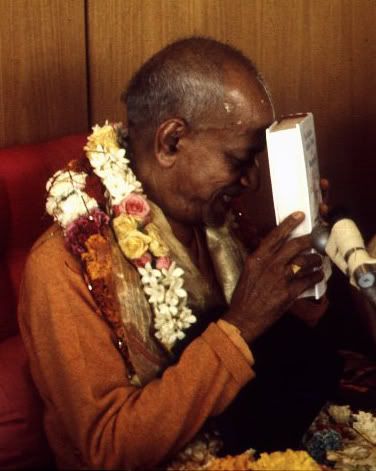
Inspired by the "Nectar of Devotion" lecture series given by His Divine Grace Srila Prabhupada from October 20-November 13, 1972 at the Radha-Damodara Temple in Vrndavana, India

All of these lectures are available for download at ISKCON Desire Tree.

Lectures #2 and #3
10-21-72 and 10-23-72

It was a great gift of Prabhupada's transcendental timing that his arrival in the West came during a day in which a wholesale abandoning of contemporary values by the youth of the day was catching fire.

No longer were the visions and lifestyles of good ol' ma and pa something that would give satisfaction to these driven and daring seekers-through the help of a very flavorful cosmic soup, they had begun to see through the illusions of a mass-production, mass-consumption society that had little heart to offer.

The "Leave It To Beaver" aesthetic did not compute to many of these young men and women-some of whom would become Prabhupada's dear followers. They had the inkling of a realization about the real nature of the "reality" that faced them.

In his purport to verses 11-12 from the chapter "Departure of Lord Krsna to Dvaraka" from the First Canto of the Bhagavatam, Prabhupada writes:

"Material society, friendship and love are all different phases of lust. Home, country, family, society, wealth and all sorts of corollaries are all causes of bondage in the material world, where the threefold miseries of life are concomitant factors. By associating with pure devotees and by hearing them submissively, attachment for material enjoyment becomes slackened, and attraction for hearing about the transcendental activities of the Lord becomes prominent."

Speaking to his students this evening in Vrndavana, Prabhupada is giving the sastric weight to their frustrations and revolt against the values of contemporary society. He is confirming their frustration and, more importantly, telling them how to find the real peace and happiness that will end this frustration.

How to do so is by linking up with the merciful process of devotional service, with the mission of Caitanya Mahaprabhu, by answering the plea of Lord Nityananda as he rolls in the dust before in you, straw in his mouth, begging you to become absorbed in the Holy Name.

In the preface to the Nectar of Devotion, Prabhupada writes:

"When the purified senses are employed in the service of the Lord, one becomes situated in bhakti-rasa life, and any action performed for the satisfaction of Kṛṣṇa in this transcendental bhakti-rasa stage of life can be relished perpetually. When one is thus engaged in devotional service, all varieties of rasas, or mellows, turn into eternity. In the beginning one is trained according to the principles of regulation under the guidance of the ācārya, or spiritual master, and gradually, when one is elevated, devotional service becomes automatic and spontaneous eagerness to serve Kṛṣṇa."

Clinging to the lotus feet of our spiritual master, and of all those who take it upon themselves in their mercy to guide our fragile journey into spiritual life, is the only valid ticket to the "automatic and spontaneous eagerness to serve Krsna" that is our truest birthright and most natural condition of the soul.

Saksad-dharitivena samasta sastre...The spiritual master is as good as the Supreme Person. Because he is the most humble, the most merciful representative of the Lord. He is completely qualified and completely able to give the Lord's mercy to the conditioned souls.

Prabhupada says in his lecture: "He does not think himself as spiritual master. He thinks himself their servant. Because they have to be trained. Krsna has appointed him to train them. Therefore he thinks himself as servant of the disciples. This is the position."

Prabhupada's position, his service in teaching the practical application of the Absolute Truth to his young students, was to help them understand their frustrations with the "status quo" had a deeper taste to them.

They did not want to identify with the designations of a hypocritical society based on greed and hatred. It is a craziness that the sanity of their heart's calling prevents them from giving into, and Prabhupada confirms this when he says:

"But in my opinion, every man is a crazy man." So this is a fact. This is a fact. Anyone who is under the control of the material energy, he's a crazy man. He's thinking "I am this, I am that, I am this," "I am American," "I am Indian," "I am Hindu," "I am a Muslim," "I am so on, so on, so many things." But he's nothing of all this. These are all creation of mäyä."

Real self-realization means a personal identification beyond these mere material designations. Going beyond these unhealthy identifications means going beyond hankering and lamenting, and it also means going beyond harmful conflict, destroying the very source, the ahankara, of all war and conflict.

We can share in Prabhupada's service by our eagerness to share the message of Krsna Consciousness. Our eagerness to share is the fee for the valid ticket of attachment to the lotus feet of Guru and Gauranga mentioned above. Prabhupada says in his lecture:

"A devotee should not only give respect to the devotees, but he should try to make others a devotee. That means preaching. What is the meaning of this preaching. People are engaged in material activities, and the preacher should approach them that 'You are spoiling your time, my dear sir. You become devotee of Krsna.' This is preaching. 'You are simply spoiling. You have got this human form of life, but you are utilizing like animals—eating, sleeping, mating and defending.'"

Ultimately, it is about love. It was love, after all, that the heady youth of the sixties were after in all their perverted guises and methods. It is, in fact, what we are always after in our words and deeds, but we tragically have little clue how to find the real, everlasting love of legend, fable, and fame.

Here again is where Prabhupada swoops in with the straight dope. In the preface to the NOD, he writes:

The basic principle of the living condition is that we have a general propensity to love someone. No one can live without loving someone else. This propensity is present in every living being. Even an animal like a tiger has this loving propensity, at least in a dormant stage, and it is certainly present in the human beings.

The missing point, however, is where to repose our love so that everyone can become happy. At the present moment, the human society teaches one to love his country or family or his personal self, but there is no information where to repose the loving propensity so that everyone can become happy.

That missing point is Krsna, and the Nectar of Devotion teaches us how to stimulate our original love for Krsna and how to be situated in that position where we can enjoy our blissful life."
It is a pure love, the nectar of our hearts, covered over by our moldy, rotten conditioning, that is to be uncovered by our fealty, our devotion to Prabhupada and to Krsna. By our love, our commitment in this duty, then it is the service of the acaryas to help us to uncover this original pure love in our hearts.

What is the substance of this pure love? Prabhupada says:

"In the material world field, we love somebody for getting something in return. That is not love, pure love. Pure love is different. Pure love, as it is described by Lord Caitanya, in the, in His mood of Rädhärani unto Krsna:

aslisya va pada-ratam pinastu mam
adarsanan marma-hatam karotu va
yatha tatha va vidadhatu lampato
mat-prana-nathas tu sa eva naparah


This is love, Rädhärani''s, that 'You either embrace Me or trample Me down under your feet, neglect Me, or make Me broken-hearted, not being present at any time throughout My life, life after life, it does not matter. Still I love you unconditionally.'That is real love. And that love is existing in everyone's heart."

We can reawaken this love by following in the footsteps of the great acaryas, in the methods prescribed to us by Rupa Goswami.

Thursday, June 25, 2009

C/O President Obama Part 2

Thanks to our dear friend Ananda, we have Vol.2 of Leadership For An Age of Higher Consciousness ready to be sent to the White House.

We're now looking for a kind soul to donate Vol.1 All the info is below

There is a desperate need for spiritual leadership. There is desperate need for the leaders of our world to know how to care for their constituents, to know how to inspire others to serve and sacrifice for the greater good, and to bring people back to their awareness of the Supreme, the Divine, to Krsna.

In this mood, I am hoping someone will sponsor a copy of the timeless tome from HH Bhakti-Tirtha Swami, Leadership For An Age of Higher Consciousness, so that we can send it to the White House in the hopes it will reach the hands of President Obama, and enhance his already sincere style of leadership, and take it and us to a higher level.

This is real "shoot the rhino" strategy, in the mood of Prabhupada, who would always try to contact big world leaders like Gandhi, Indira Gandhi, the Pope, and even Richard Nixon.

If you would like to help, either leave a comment with contact info, or write us at nvclub108@gmail.com.

Wednesday, June 24, 2009

Beefing Up Appeals To Save Cows

From the 6-23-09 edition of the Wall Street Journal

NEW VRINDABAN, W.Va. -- Saving cows, the Hare Krishnas in this village have learned, is a lot easier in India.

Created four decades ago, New Vrindaban was the first cattle sanctuary in the U.S. At its peak, it had 434 bovine refugees. Today, the cattle population is down to 80 because there's not enough money to support more. So the Hare Krishna community is borrowing a tactic more commonly used by charities that try to save people.

In New Vrindaban, Hare Krishnas have built a sanctuary for cows, which they consider sacred. The 80 beloved bovines here are treated by their Hindu caretakers like members of the family.

For $51, you can feed a cow for a month, while $108 would "provide special care for retired cows who can no longer breed or give milk," the group says in one appeal. "In one selfless stroke, you are sending a valuable message to our children and to a troubled world which sees today's gentle cow as tomorrow's dinner."

The adopt-a-cow effort promises bovine photographs and updates for donors, along with an open invitation to visit the cows in this village, near Moundsville, W.Va. The village is modeled after the childhood home of the Hindu deity Krishna, who taught his followers to revere cows.

Vishwa Hindu Parishad of America, a Hindu group that grew out of a movement to ban the slaughtering of cows, has joined the Hare Krishna effort with its own appeals to help raise the roughly $1,000 needed to support each cow for a year. "It is needless to mention that by taking special care of Lord Krishna's cows you and your family will definitely receive His special blessings," reads another appeal, targeting the estimated 1.5 million Hindus in the U.S., recently posted on the group's Web site.

'Party Animal'

Other Hare Krishna groups in the U.S. also offer adoption programs, including one just up the road, called the International Society for Cow Protection. It posts names and profiles of cattle available for adoption on its Web site, calling one a "party animal and break-out artist" and another "Mister Handsome Heartbreaker."

Cows are sacred to Hindus, a status allowing them to roam the streets of India untouched. Most Indian states prohibit their slaughter, although an illegal beef trade thrives. Krishna is believed to have encouraged the people of Vrindaban, India, to worship the land and animals that support them, preaching the power of cows to provide everything from milk for children to manure for farming.

The cows at New Vrindaban -- from the oldest of the herd to the youngest calf, 6-month-old Rama -- are doted on, often getting hugs and kisses. Devotees offer the cows' milk to Krishna in religious ceremonies and use it to make butter, yogurt and sweets.

"We look at them like our own mothers," says Ranaka Das, 54 years old, a cow caretaker. Once known as Doug Fintel, he worked at a Coors brewery in Colorado before joining the Hare Krishna movement and moving to New Vrindaban in 1977. "You take care of them like your own family," he said. "In a regular dairy operation, cows are like any piece of machinery."

Milind Bharambe, a Pittsburgh software analyst who immigrated from India nine years ago, initially sought a reward of sorts for helping to save the animals. "Cows are very dear to Krishna," he says. "If I help someone very dear to Krishna, maybe I might benefit," he thought.

[cow]

But today, Mr. Bharambe -- who donates about $800 a year to New Vrindaban, half earmarked for the cows -- says his motivation is more spiritual. "I'm supporting someone very dear to Krishna. That thought itself gives so many things. You feel happiness. You feel better."

Many of New Vrindaban's cows were born on site. Devotees occasionally rescue doomed cows from slaughterhouses and bring them to the sanctuary.

"Slaughtering an animal is not natural for human beings," said Rishi Shinde, a Dallas businessman who donates about $360 a year to sponsor one cow. "It affects one's consciousness, makes one violent and makes one lose contact with the emotional self."

New Vrindaban's cow farm, or goshala, includes a giant barn for the cattle -- as many as 200 -- which spend most of their day grazing on the pasture. Only half a dozen of the 80 cows still produce milk, about 50 pounds of it a day. The rest of the cattle are left to carry out their natural lives -- as long as 20 years -- far longer than the life span for many U.S. cattle raised for slaughter.

Seventies Devotees

At the top of a winding West Virginia road, New Vrindaban was established in a small farmhouse in 1968 with 100 acres by two American disciples of Swami Prabhupada, an Indian who moved to New York City to spread his love for Krishna. As the Hare Krishna movement expanded with hippies-turned-devotees in the 1970s, hundreds of Americans -- 700 at one point, the group says -- moved to New Vrindaban, took up robes and Sanskrit names and assumed a mission of protecting cows, growing their own food and building temples.

They raised money selling wares at street corners and airports nationwide, pouring their funds into materials to build, by hand, an ornate temple for Prabhupada on the site of a former trash dump. Completed in 1979, two years after his death, Prabhupada's Palace of Gold became a shrine. Tourists came by the busload, drawing more publicity, devotees and money -- millions of dollars a year. New Vrindaban grew to 3,000 acres.

A 1986 murder of a former devotee sent the community into turmoil. Authorities raided the community, sparking years of investigations into allegations of murder, racketeering and child abuse. The New Vrindaban founder who was alleged to have ordered the murder eventually went to prison for racketeering. He received a 20-year prison sentence, which was then reduced to 12 years due to poor health. He served eight years.

New Vrindaban's cow sanctuary sits alongside communities that raise cattle for other purposes.

Today, the New Vrindaban area has fewer than 200 resident devotees, about a quarter of them of Indian descent. The site still draws about 25,000 visitors a year, the group says. A donation of $6 is sought from those who visit the Palace of Gold. Visitors of Indian descent take special interest in the cows, often bringing their children to pet the animals.

That doesn't produce the $100,000 a year needed to pay for hay, the barn, workers and property taxes. Hence the adopt-a-cow fund raising. The leaders of the community say only a few of the cows are sponsored in full for life by the donations, which are tax-deductible. But they are clear about one thing: None of these cows ever leave for the slaughterhouse.

"We've kept that promise to Pradhupada and the cows since we first came here," says Nityodita Das, one of the community's current leaders.

The Hare Krishnas' cow-protection campaign doesn't seem to be getting much traction with some neighbors. "There's not much of a push around here to save cattle," says Allen Hendershot, Moundsville city manager. "Cattle are raised for a reason."

Indeed, drivers exiting Interstate 470 in Bethlehem, W.Va., to reach New Vrindaban recently were greeted by a giant sign in the median featuring a bovine cartoon, promoting a nearby event. It read: "Bethlehem Steak Fry."

Write to Sudeep Reddy at sudeep.reddy@wsj.com


Tuesday, June 23, 2009

A Righteous Escape

From the Sunday, June 21st edition of the New York Times

The government limits the number of monks allowed to live in the monastery, they said. Officials cracked down on festivities honoring the Dalai Lama. When the Chinese-appointed Panchen Lama visited Labrang several years ago, monks were forced to stay indoors to prevent disturbances.

Last year, when monks in Lhasa, the Tibetan capital, began leading peaceful protests on March 10, word spread quickly to Labrang.

Thousands of monks and lay people in Xiahe marched to government offices demanding the return of the Dalai Lama. Some protesters broke into buildings and threw stones at riot police officers.

From then on, the government tightened the screws on the monastery, the monks said. A curfew was imposed. Security officers arrested several monks each night. The monastery began to empty out.

“Some monks ran off to their homes in the countryside,” said Jamyang Jinpa, 24.

The authorities began holding daily hourlong patriotic education classes, in which the monks were forced to read tracts denouncing the Dalai Lama and pledge loyalty to the Communist Party.

“As a Buddhist monk who believes in the Dalai Lama as our foundation, it was unbearable to read this,” Lobsang said.

On the night of April 8, some monks heard on the radio that foreign journalists were to arrive in Labrang the next day on a government tour.

“We immediately stopped what we were doing that night and started discussing the protest,” Jamyang said.

A half-dozen monks brought out a Tibetan flag and scrawled slogans on three white banners. “We have no freedom of speech,” read one. They wrote their wills on the back of the flag because they thought there was a good chance they would be killed by Chinese security forces, Jamyang said.

When they went to the main temple the next morning, they were struck by a strange sight: Hundreds of people were milling about the square outside. Most were plainclothes Chinese security officers.

“We knew then that the journalists were coming,” Jamyang said. “We pretended to visit the temple.”

When the journalists and their government escorts pulled up in minivans, the monks dashed across the square, unfurling their flag and banners. A few words were exchanged in Chinese. Some monks draped white ceremonial scarves around the necks of several journalists.

“The Chinese people in plainclothes took photos of us, but they dared not stop us in front of the journalists,” Jamyang said.

That night, security officers searched the cells of the monks involved in the protest, but the monks had hidden elsewhere. The next night, Jamyang slipped into the mountains and kept walking until dawn.

“After the protest, I felt I would be arrested at any time,” he said.

Jamyang spent the first two months mostly sleeping outdoors, he said, sometimes in ditches that he had dug himself. He tossed away his red robes and began growing out his hair. In the summer, he wandered to the high pastures and slept in the tents of nomads.

“In my dreams, sometimes I would see myself getting shot and dying,” he said.

Two other monks from the protest, Lobsang and Jigme Gyatso, also fled the monastery in the days after Jamyang left. The three stayed apart. After nearly a year in hiding, the monks learned of a guide in Lhasa who could smuggle them into Nepal.

Using fake identification cards, they boarded the new high-altitude train to Lhasa. A driver then sneaked them past checkpoints to the Nepal border, where they crossed a river on logs.

Of the 15 monks who took part in that protest in front of the journalists, only these three have escaped to India. That they made it here is considered extraordinary given how tightly Chinese authorities clamped down on Tibet. The refugee center here usually gets 2,500 to 3,000 Tibetans per year, but that dropped to 550 last year. By the end of May, only 176 refugees had arrived, said Ngawang Norbu, the center’s director.

The monks say they have no regrets about holding the protest — to them, there was no other way to show the world their true feelings about Chinese rule.

“I miss my friends and family in Tibet, but I try to bury my feelings,” Jamyang said. “At the moment, I can’t return to Tibet, and I don’t know about the future.”


Thursday, June 18, 2009

The Nectar Chronicles: Part 1

Inspired by the "Nectar of Devotion" lecture series given by His Divine Grace Srila Prabhupada from October 20-November 13, 1972 at the Radha-Damodara Temple in Vrndavana, India

All of these lectures are available for download at ISKCON Desire Tree.

Let me set the scene...

It is autumn in Vrndavana. The clouds have broken in the rainy season, a natural metaphor of the mercy of Caitanya Mahaprabhu that has broken through to the Western world.

Prabhupada describes it thusly in the "The Description of Autumn" chapter of Krsna book: "As clouds sometimes clear, even in the rainy season, and sometimes the moon, stars and sun become visible, so even in this Kali-yuga there are sometimes advantages. For example, sometimes Lord Caitanya’s Vedic movement of distributing the chanting of the Hare Krsna mantra is heard. People seriously eager to find real light should take advantage of this movement instead of looking toward the light of mental speculators and atheists."

Surrounded by a transcendental gaggle of his young, eager,confused, and very sincere disciples from the mleccha-lands, the acarya, the best friend, the magnificent personality that is Srila Prabhupada expounds on the basics of Krsna Consciousness, laying the literal foundation for the worldwide spreading of his mission for the benefit of all living entities.

Thanks to the minor miracles of modern recording technology, we, as his disciples and grand-disciples and so on, have the unique situation of having the sound of the acarya, the words of the acarya, and the presence of the acarya available freely at our fingertips and eardrums at any given moment.

These are my humble reflections on these timeless and priceless lectures, the words of Srila Prabhupada, the parampara passing through him and in him, to us now and forever.

Lecture #1
10-20-72


Srila Prabhupada knows that his young disciples, those his spiritual master has sent to him to help him fulfill his mission, are raw and prone to easy and heavy misjudgement and misunderstanding.

So, although he is speaking from the very exalted platform of the Bhakti-Rasamrta-Sindhu by Srila Rupa Goswami, which has been translated by Prabhupada, who like Srila Vyasadeva is very kind to the ignorant masses, into The Nectar of Devotion, we are really here in Krishna Consciousness 101, and we should relish every moment.

This is our chance to stand on the firmest ground, to build the strongest foundation, simply by our attentive and respectful hearing.

Rupanugas
...Who is the personality behind this foundation? It is Srila Rupa Goswami. Prabhupada says our aim of life must be to serve the mission of the acaryas. By this service, in its many dynamic forms and expressions, we actually associate with Rupa Goswami and all the acaryas personally

Another brick in the transcendental wall of our foundation is the association of the devotees, the cypher and medium through which we gain the opportunity for loving service exchanges wherein this personal association of the acaryas lies, waiting to bear its fruit.

Siddhanta...the conclusions of the acaryas are the lighthouse of clarity in the dark sea of the Kali-Yuga. Prabhupada says to the assembled Vaisnavas:

"Those who are advanced devotee, they know siddhänta, the conclusion. In the Caitanya-caritämåta, therefore, it has been advised, siddhänta baliyä citte nä kara alasa ihä haite krsna läge sudrdha mänasa [Ädi 2.117]

If you neglect siddhänta, conclusion, given by the äcäryas, then you will misunderstand Krsna. Krsna, therefore Narottama däsa Thäkura says... These are the evidences.
Narottama däsa Thäkura, such an exalted äcärya, he's teaching us, "Don't try to understand yugala-piriti, the love affairs between Rädhä and Krsna, concoctedly, by your own concoction." No.

You should first of all try to serve the Six Gosvämis, rüpa-raghunätha-pade haibe äkuti, how they are directing. Just like this Bhakti-rasämåta-sindhu. Srila Rüpa Gosvämi is not teaching in the beginning the loving affairs of Rädhä-Krsna. No. He's training, first of all, the reader, the devotee, how to become first of all pure devotee."


If we jump, we shall fall...fall right off the cliff. Prabhupada warns his young disciples, he warns us, that we shouldn't take off the training wheels until we know how to balance ourselves, until we know how to ride the bike of Vaisnava etiquette, until we have real, honest, active faith in the siddhanta of the acaryas.

We cannot re-establish our relationship with Krsna artificially, or as Prabhupada reveals by metaphor, we cannot force the sun to rise. It is revealed gradually, with proper training. Svarup-siddhi, our natural position, is revealed gradually.

Prabhupada also knows that some of his young disciples are still impressionable to the impersonalist gobbly-gook they discovered in their psychedelic journey to the promised land.

Similar to the "stay high forever" rhetoric of the 2nd Avenue days, Prabhupada relates that the impersonalist may shoot into the effulgence like a rocket, buoyed by his austerities, but like the rocket, unless it finds a planet to land on and engage, one cannot float forever. One must come back down.

Whether its psychedelic seasoning or millions of lifetimes of cold-cave austerities, without Krsna in the center, the results are not permanent. The fruits eventually become dry, spoiled, and rotten.

Prabhupada is very careful to make clear that artificial bhajan invariably leads back to sense pleasure. It does not lead to Krsna. If we jump, we will fall down.

***

Our training ground is our preachings. Our college classrooms. Our bhakti-vrksa gatherings. Our festival delights. Our subway book distributions. Every inch of the globe stands ready to be used to rescue our faltering excuse of an civilization to the feet of the acaryas.

Prabhupada's encouragement is simple but completely rock-solid. We should just try to preach this message, and the more strength we will get to go on further and further, reaching more and more people, entering into newer and uncharted territories.

This is the best welfare activity for everyone. Better than political rallies, petitions, and seditions. The welfare it gives is free and real.

It hits the soul, like a Trane refrain, and brings the love so lacking, filled in its void by a hatred, a collection of aparadhas, that sears the very idea of our actual identity, of the peace and self-realization that is our eternal birthright.

Anyone who is preaching the message of Lord Caitanya is most, most dear to Krsna. It is His desire, His will, and His greatest pleasure that we preach the siddhanta of the acaryas to our fellow uncovered devotees and covered-over devotees, whomever we know and whomever we will meet.

And preaching is not difficult. We are simply to establish that Krsna is the Supreme Personality of Godhead. Isvarah paramah krsna. We must become sincerely convinced and then we can also convince others.

Prabhupada says the test of advancement of our sincerity as we build our foundations in Krsna Consciousness, is to experience oneself as different in mood, thoughts, and actions from the karmis, jnanis, etc.

If we walk down the street, and we feel different from those around us, if we don't desire the mundane that surrounds us, then we are pushing through. The rainy season is beginning to clear, and the sunlight of the Supreme Lord is beginning to shine through

(Of course, if we walk down the street, and we feel different from others, yet don't feel proud or superior because of it, then that is a further, higher level of advancement)

Another example is our willingness to give up the non-essential comforts in our life (Speaking from the brahmacari side is the clear realization that we don't require furniture) to find the better engagement.

Letting go of our lesser tastes makes room for the higher tastes. It makes room for the real bricks, the real spiritual cement we have to have in place to survive and thrive as the servants, the personal associates of the acaryas.