Thursday, June 10, 2010

Are There Dangers In Being "Spiritual But Not Religious?"

By John Blake, from CNN Living
June 4, 2010 1:28 p.m. EDT
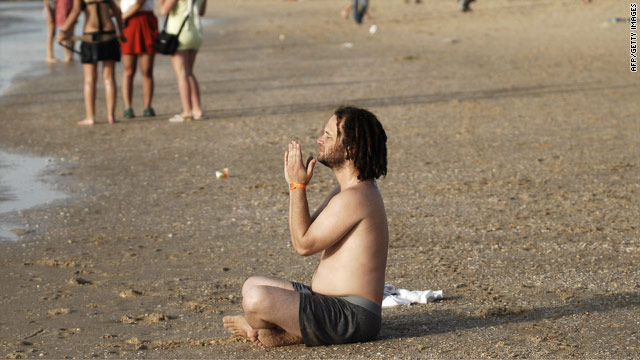
Being "spiritual but not religious" means you do not  need a church or a community, some say. A beach will do.
Being "spiritual but not religious" means you do not need a church or a community, some say. A beach will do.

(CNN)
-- "I'm spiritual but not religious."

It's a trendy phrase people often use to describe their belief that they don't need organized religion to live a life of faith.

But for Jesuit priest James Martin, the phrase also hints at something else: egotism.

"Being spiritual but not religious can lead to complacency and self-centeredness," says Martin, an editor at America, a national Catholic magazine based in New York City. "If it's just you and God in your room, and a religious community makes no demands on you, why help the poor?"

Religious debates erupt over everything from doctrine to fashion. Martin has jumped into a running debate over the "I'm spiritual but not religious" phrase.

The "I'm spiritual but not religious" community is growing so much that one pastor compared it to a movement. In a 2009 survey by the research firm LifeWay Christian Resources, 72 percent of millennials (18- to 29-year-olds) said they're "more spiritual than religious." The phrase is now so commonplace that it's spawned its own acronym ("I'm SBNR") and Facebook page: SBNR.org.

But what exactly does being "spiritual but not religious" mean, and could there be hidden dangers in living such a life?

Did you choose "Burger King Spirituality"?

Heather Cariou, a New York City-based author who calls herself spiritual instead of religious, doesn't think so. She's adopted a spirituality that blends Buddhism, Judaism and other beliefs.

"I don't need to define myself to any community by putting myself in a box labeled Baptist, or Catholic, or Muslim," she says. "When I die, I believe all my accounting will be done to God, and that when I enter the eternal realm, I will not walk though a door with a label on it."

People seem not to have the time nor the energy or interest to delve deeply into any one faith or religious tradition.
--June-Ann Greeley, theology professor

BJ Gallagher, a Huffington Post blogger who writes about spirituality, says she's SBNR because organized religion inevitably degenerates into tussles over power, ego and money.

Gallagher tells a parable to illustrate her point:

"God and the devil were walking down a path one day when God spotted something sparkling by the side of the path. He picked it up and held it in the palm of his hand.

"Ah, Truth," he said.

"Here, give it to me," the devil said. "I'll organize it."

Gallagher says there's nothing wrong with people blending insights from different faith traditions to create what she calls a "Burger King Spirituality -- have it your way."

She disputes the notion that spiritual people shun being accountable to a community.

"Twelve-step people have a brilliant spiritual community that avoids all the pitfalls of organized religion," says Gallagher, author of "The Best Way Out is Always Through."

"Each recovering addict has a 'god of our own understanding,' and there are no priests or intermediaries between you and your god. It's a spiritual community that works.''

Nazli Ekim, who works in public relations in New York City, says calling herself spiritual instead of religious is her way of taking responsibility for herself.

Ekim was born in a Muslim family and raised in Istanbul, Turkey. She prayed to Allah every night, until she was 13 and had to take religion classes in high school.Then one day, she says she had to take charge of her own beliefs.

"I had this revelation that I bow to no one, and I've been spiritually a much happier person," says Ekim, who describers herself now as a Taoist, a religious practice from ancient China that emphasizes the unity of humanity and the universe.

"I make my own mistakes and take responsibility for them. I've lied, cheated, hurt people -- sometimes on purpose. Did I ever think I will burn in hell for all eternity? I didn't. Did I feel bad and made up for my mistakes? I certainly did, but not out of fear of God."

Going on a spiritual walkabout

The debate over being spiritual rather than religious is not just about semantics. It's about survival.

Numerous surveys show the number of Americans who do not identify themselves as religious has been increasing and likely will continue to grow.

A 2008 survey conducted by Trinity College in Hartford, Connecticut, dubbed these Americans who don't identify with any religion as "Nones."

"I don't need to define myself in a box labeled Baptist, or Catholic, or Muslim."
--Heather Cariou, a spiritual but not religious seeker

Seminaries, churches, mosques and other institutions will struggle for survival if they don't somehow convince future generations that being religious isn't so bad after all, religion scholars warn.

Jennifer Walters, dean of religious life at Smith College in Massachusetts, says there's a lot of good in old-time religion.

Religious communities excel at caring for members in difficult times, encouraging members to serve others and teaching religious practices that have been tested and wrestled with for centuries, Walters says.

"Hymn-singing, forms of prayer and worship, teachings about social justice and forgiveness -- all these things are valuable elements of religious wisdom," Walters says. "Piecing it together by yourself can be done, but with great difficulty."

Being a spiritual Lone Ranger fits the tenor of our times, says June-Ann Greeley, a theology and philosophy professor.

"Religion demands that we accord to human existence some absolutes and eternal truths, and in a post-modern culture, that becomes all but impossible," says Greeley, who teaches at Sacred Heart University in Connecticut.

It's much easier for "spiritual" people to go on "spiritual walkabouts," Greeley says.

"People seem not to have the time nor the energy or interest to delve deeply into any one faith or religious tradition," Greeley says. "So they move through, collecting ideas and practices and tenets that most appeal to the self, but making no connections to groups or communities."

Being spiritual instead of religious may sound sophisticated, but the choice may ultimately come down to pettiness, says Martin, the Jesuit priest, who writes about the phrase in his book, "The Jesuit Guide to (Almost Everything)."

"Religion is hard," he says. "Sometimes it's just too much work. People don't feel like it. I have better things to do with my time. It's plain old laziness."

Wednesday, June 2, 2010

Many Faiths, One Truth

An op-ed from The Dalai Lama, appearing in the 5-25-10 edition of the New York Times

WHEN I was a boy in Tibet, I felt that my own Buddhist religion must be the best — and that other faiths were somehow inferior. Now I see how naïve I was, and how dangerous the extremes of religious intolerance can be today.

Though intolerance may be as old as religion itself, we still see vigorous signs of its virulence. In Europe, there are intense debates about newcomers wearing veils or wanting to erect minarets and episodes of violence against Muslim immigrants. Radical atheists issue blanket condemnations of those who hold to religious beliefs. In the Middle East, the flames of war are fanned by hatred of those who adhere to a different faith.

Such tensions are likely to increase as the world becomes more interconnected and cultures, peoples and religions become ever more entwined. The pressure this creates tests more than our tolerance — it demands that we promote peaceful coexistence and understanding across boundaries.

Granted, every religion has a sense of exclusivity as part of its core identity. Even so, I believe there is genuine potential for mutual understanding. While preserving faith toward one’s own tradition, one can respect, admire and appreciate other traditions.

An early eye-opener for me was my meeting with the Trappist monk Thomas Merton in India shortly before his untimely death in 1968. Merton told me he could be perfectly faithful to Christianity, yet learn in depth from other religions like Buddhism. The same is true for me as an ardent Buddhist learning from the world’s other great religions.

A main point in my discussion with Merton was how central compassion was to the message of both Christianity and Buddhism. In my readings of the New Testament, I find myself inspired by Jesus’ acts of compassion. His miracle of the loaves and fishes, his healing and his teaching are all motivated by the desire to relieve suffering.

I’m a firm believer in the power of personal contact to bridge differences, so I’ve long been drawn to dialogues with people of other religious outlooks. The focus on compassion that Merton and I observed in our two religions strikes me as a strong unifying thread among all the major faiths. And these days we need to highlight what unifies us.

Take Judaism, for instance. I first visited a synagogue in Cochin, India, in 1965, and have met with many rabbis over the years. I remember vividly the rabbi in the Netherlands who told me about the Holocaust with such intensity that we were both in tears. And I’ve learned how the Talmud and the Bible repeat the theme of compassion, as in the passage in Leviticus that admonishes, “Love your neighbor as yourself.”

In my many encounters with Hindu scholars in India, I’ve come to see the centrality of selfless compassion in Hinduism too — as expressed, for instance, in the Bhagavad Gita, which praises those who “delight in the welfare of all beings.” I’m moved by the ways this value has been expressed in the life of great beings like Mahatma Gandhi, or the lesser-known Baba Amte, who founded a leper colony not far from a Tibetan settlement in Maharashtra State in India. There he fed and sheltered lepers who were otherwise shunned. When I received my Nobel Peace Prize, I made a donation to his colony.

Compassion is equally important in Islam — and recognizing that has become crucial in the years since Sept. 11, especially in answering those who paint Islam as a militant faith. On the first anniversary of 9/11, I spoke at the National Cathedral in Washington, pleading that we not blindly follow the lead of some in the news media and let the violent acts of a few individuals define an entire religion.

Let me tell you about the Islam I know. Tibet has had an Islamic community for around 400 years, although my richest contacts with Islam have been in India, which has the world’s second-largest Muslim population. An imam in Ladakh once told me that a true Muslim should love and respect all of Allah’s creatures. And in my understanding, Islam enshrines compassion as a core spiritual principle, reflected in the very name of God, the “Compassionate and Merciful,” that appears at the beginning of virtually each chapter of the Koran.

Finding common ground among faiths can help us bridge needless divides at a time when unified action is more crucial than ever. As a species, we must embrace the oneness of humanity as we face global issues like pandemics, economic crises and ecological disaster. At that scale, our response must be as one.

Harmony among the major faiths has become an essential ingredient of peaceful coexistence in our world. From this perspective, mutual understanding among these traditions is not merely the business of religious believers — it matters for the welfare of humanity as a whole.

Tenzin Gyatso, the 14th Dalai Lama, is the author, most recently, of “Toward a True Kinship of Faiths: How the World’s Religions Can Come Together.”

Thursday, May 20, 2010

Spirituality In Higher Education: Overcoming The Divide

by Arthur Zajonc, a professor of physics at Amherst College in Massachusetts

Click here to read the full article.


"I believe that discoveries in science, artistic breakthroughs, and even the more common successes we experience in the classroom are instances of an apercu breaking into our habitual awareness with novel cognitive insights. To quote Emerson once again, "No discovery is ever made except by poetic perception."

How do we fashion the new eyes that lead to the novel apercu? The very act of attention shapes these capacities. In Goethe's words, "Every object well contemplated creates an organ for its perception."

In a letter to Emil Bernard, Cezanne wrote: "Nature is the true teacher, and through looking and working we must make ourselves concentric to her." That is to say, we start eccentric to nature, off center. Through our constant attention to her we become concentric, we reshape ourselves with every stroke on the canvas to be in alignment with her. Goethe was amazed by our malleability.

To grasp the phenomena, to fix them to experiments, to arrange the experiences and know the possible modes of representation of them ... demands a molding of the poor human ego, a transformation so great that I never should have believed it possible. I view the transformation of the self as the highest form of education."

Sunday, May 16, 2010

Fear And Loathing In Heaven?

By Satyam Kaswala for ISKCON News on 11 May 2010
Image: www.freeuni.edu.ge
To love God or to fear God? That is the question.

As I was driving down an interstate road late one breezy spring night, I read a billboard signed by God. But I felt no tranquility, no joy. My lips grew so heavy I could not smile. I was gripped by a strange, suffocating unease.

“DON’T MAKE ME COME DOWN THERE,” it angrily warned.

The warmth of the moonlight, which felt like God’s smiling, protective eye gazing directly at me as it hit my skin and illuminated the darkness, suddenly became an intrusive beast that was lighting the darkness ahead of me only to see me crash in it. In that moment, the earth became a lost city.

Is God not already present in the soul of every living being, and reflected in every non-living thing? And more strikingly, why (on earth) would God “coming down” in His personal form ever be a thing to fear? Indeed, mankind has no greater dream: it is a prospect that every life of every civilization in human history has lived and died for, and will continue to live and die for - whether at its occurrence skeptics will look and say, with matter-of-factness, “proof,” or followers will say, with tears in their eyes, “at last.”

But that was the billboard’s intention exactly: instilling fear. Fear, the most dangerous of all human emotions, the catalyst of inaction. And when it comes to authentic spirituality, there is no greater demon than inaction, because it not only prevents progress itself, but also eliminates the will to progress. Our very lives are expressions of our past spiritual progress, and because of the inaction that fear can enable, there will be nothing left to express, no higher lives to live for. How can we confidently and faithfully climb higher if the very mountaintop we are climbing towards is telling us to be afraid of heights? We cannot.

When once asked by a devotee what he felt when he chanted the holy names of the Lord (which of course is non-different than experiencing God Himself) Srila Prabhupada replied with that characteristic lack of hesitancy only attainable by someone who has seen the face of Truth:

“I feel no fear.”

My heart began to vibrate as I read those words. It was my soul, shaking with ecstasy. Srila Prabhupada was saying to live without fear is to be with God. Of course, there is no way to escape fear in this world except through taking shelter in God Himself, through His transcendental names, so that they are embedded into our very heartbeat, our very lifeline, so that even when we are not actively saying them they sustain our existence, at which point our hearts are no longer even beating but rather dancing. And to embrace God in this way is the most courageous thing one can do in this universe.

But to portray God not only as an angry punisher, but as the source of all fear as the billboard implies, was one who would rather intimidate us with His absence and threaten us with His presence, rather than act as a loving protector, who, by contrast, yearns to deliver us from that very absence and longs to be with us, seems criminally counterproductive. Because it brings our sincerity into question: are we acting out of love or self-interest?

Some may say the answer to this question does not matter in spirituality, as long as we believe; on the contrary, it could not matter more, because the answer breeds an even more fundamental question: is it actually God we seek, or simply the security of the place where He lives? Or, expressed in biblical language, God may have created the heavens and the earth- but did He not exist before that?

I believe the mentality, so prevalent in materialistic culture, that appeals to our lower selves (through fear) rather than our higher selves (through love) repels people from religion, and infinitely worse, from God. Especially young people, who are already disillusioned by fear-mongering, whether by political leaders, parents, or organized religion itself. One example of this repulsive mentality is the group of so-called religious preachers who stand outside the public events and shopping centers of America condemning individuals who, because God “hates” them, are doomed to suffer eternally in hell. Homosexuals. Liberals. Non-fundamentalist Christians. Their list is endless. It is manifested in senseless religious wars. It is manifested in the dangerous notion that the road to enlightenment is paved only with guilt. And it is manifested in the billboards that fail to guide us and have nothing worthwhile to say. People see these atrocities and turn the other cheek. Unconditional love of God cannot exist in a culture that calls hope rage.

This is a reason that the Lord triumphantly declares in the Bhagavad-Gita, “Abandon all varieties of religion and just surrender unto Me. I shall deliver you from all sinful reactions. Do not fear.” (18.66)

Thus to embrace and surrender to God is to be fearless. But fear is hardly real; it is an illusory construction of the mind. As verse 15.7 from the Gita states, “the conditioned soul is bound up, as though shackled by iron chains. He is bound up by the false ego, and the mind is the chief agent which is driving him in this material existence.” Therefore, rather than pander to the basest emotion of the disturbed, ephemeral mind, perpetually agitated by temporary material conditions and pulled by chains like a dog, why not appeal directly to the Soul, eternal and brimming with God’s present love, and change the angry, spiteful message that induces aversion from God (as reflected in the billboard) to the achingly beautiful and comforting one that attracts us to God (Krishna, after all, means all-attractive) and is reflected in the Lord’s blissful words in the passage quoted above?

“The Supreme Personality of Godhead said: Fearlessness; purification of one's existence; cultivation of spiritual knowledge; charity; self-control; performance of sacrifice; study of the Vedas; austerity; simplicity; nonviolence; truthfulness; freedom from anger; renunciation; tranquility; aversion to faultfinding; compassion for all living entities; freedom from covetousness; gentleness; modesty; steady determination; vigor; forgiveness; fortitude; cleanliness; and freedom from envy and from the passion for honor — these transcendental qualities, O son of Bharata, belong to godly men endowed with divine nature.” (BG 16.1)

It is no coincidence that the very first quality the Lord lists as transcendental and divine is fearlessness. Hence Srila Prabhupada’s response: “I feel no fear.”

After all, it is our own karma that ultimately punishes us, not God. But of course, in this material world, making God a scapegoat for our own fears is so much easier than meaningful self-examination.


Read more: http://news.iskcon.com/node/2799/2010-05-13/fear_and_loathing_in_heaven#ixzz0nv032ZnJ

Sunday, April 11, 2010

The Humblest People In Washington

http://incharacter.org/observation/the-humblest-people-in-washington/

The Humblest People in Washington

Amy Cunningham | Posted on 04/05/10

To understand humility and fathom its riches, we must turn the world as we know it on its axis. At first glance, these are not humble times. Young people today seek money, status, and more than their fifteen minutes of acclaim. Being unknown, or off the world's radar, isn't enough for so many. One can blog or videotape oneself into an odd sort of prominence. Here in America, our egos crave splashy careers, nicer houses, published books, and tap dance knowledge. Many people suffer and fret as they frantically look outside themselves to determine their worth.
When Sister Christiana and Mother Therese return from their lunch and the two prayer sessions that framed it, they present me with a reading on humility by Saint John Climacus. The sisters and I have been discussing humility all morning. What does it mean to be humble? Of all virtues, why is humility most important? Because their every gesture is cloaked in humility, because their low voices are so saturated with sincerity, I'm feeling rather proud of myself for getting an interview with the most humble spiritual teachers possible, certainly the most humility-enriched people residing within fifteen miles of the U.S. Capitol! But there I go, getting smug, losing my own humility again.
These cloistered nuns wear traditional habits and headdresses. They chant the divine office eight hours daily with thirteen other Poor Clare sisters in the monastery's chapel, uplifted by the candlelit glow of thirteenth-century Franciscan ritual. They pray for the nation, the president, and all people in need; they also respond to scores of prayer requests weekly. But only a few priests who come in to say Mass get to see them. People who attend chapel services can hear the nuns' ethereal voices, but their bodies are always hidden, as is their wish. "We come here to live in obscurity and die in obscurity, and usually we do not know the effect our lives and prayers have upon people," says Mother Therese, who moved here as a novice more than twenty-five years ago. The sisters are so humble as they grapple with my questions, they've already thanked me for setting their minds to humility, insisting I've taught them something about it in the process.
So I'm not sure what to expect as their slender fingers slide my way the piece of paper on which is typed the reading on humility by Saint John Climacus. We are seated in the same parlor, separated by a fine-mesh screened partition through which I can see them for the purposes of this rare conversation.
I read aloud from what they've given me: "‘Humility is constant forgetfulness of one's achievements.' Oh yes, that's good...."
"‘Humility is the disposition of a contrite soul and the abdication of one's own will,'" I read on, adding, "Oh, that's lovely too."
"Yes, but he is saying that humility is more than these things," offers Sister Christiana. "You will see when you get to the end."
I skim to the bottom of the page and read back to them: "Humility is a grace in the soul with a name known only to those who have had experience of it."
The three of us then utter little gasps you'd ordinarily reserve for fireworks. "It is indescribable wealth, a name and a gift from God." At this, the nuns seem to indicate, "Oh yes, that's it," and I stop reading to look into their delighted faces for a second.
My thirteen-year-old son cannot define humility, but he can approximate what being humble means. "That's like when you don't brag about a good thing that has happened because you don't want other people to feel bad," he says. What happens to the good thing then? I ask. "Well, you can still enjoy it and think about it," he says, "but you just keep it inside of yourself."
No, honey, it's harder than that. Humility means you stop labeling the things that happen to you as either good or bad. Your life's assignment is to greet your fellow men with the assumption that they have a good thing inside them that you are curious to discover, no matter who they are. Your narrative, your history, travels with you, but you have stopped worrying about your rank. "Each person is unique," the sisters like to say. "There is no comparison." Humility is the great equalizer. Instead of keeping up with the Joneses, try viewing poverty as a privilege, as the Poor Clares do.
The Lord finds joy in his people,
He honors the lowly.
-The Liturgy of the Hours
To understand humility and fathom its riches, we must turn the world as we know it on its axis. At first glance, these are not humble times. Young people today seek money, status, and more than their fifteen minutes of acclaim. Being unknown, or off the world's radar, isn't enough for so many. One can blog or videotape oneself into an odd sort of prominence. Here in America, our egos crave splashy careers, nicer houses, published books, and tap dance knowledge. Many people suffer and fret as they frantically look outside themselves to determine their worth. Expressions of humility are often viewed as signs of weakness, and the U.S. presidents who bow too low lose respect.
The nuns believe - and many would agree - that Western culture does not foster virtue, and more importantly, that God has gotten lost in all this. We are never responsible for our own advancement, the nuns say. God is. God takes us beyond what we thought we could do, they claim. If we come to think we were responsible for our greatness, we're misappropriating credit and thereby forgetting the One who matters most. So one large goal of cloistered life is to continually keep God at the center, nudging the striving self or ego off to one side ... or into the next room, or if you're really accomplished (but not proud, of course), the self can be nullified and made absent altogether.
One might think that it's much easier to be humble when you live in a cloister with a strict schedule, frosted windows, and a clearly delineated function (abbess, vicaress, portress, etc.) that changes after a relaxed election every three years. But the nuns are dynamic examples of how difficult true humility is to practice. In fact, the nuns say, the effort to stay humble and remain always at God's disposal clearly runs contrary to basic human instinct - their own included.
"Falling down and getting up is part of it," says Mother Therese. "The Lord sometimes asks of us more than we can do," says Sister Christiana. "Then He helps us to do it."
In the subsequent half hour, the two of them refer to themselves as sinners and failures so many times that finally I stop, a tad exasperated, to ask them, "What is it that you could possibly do that is so sinful?"
"Oh, really, the same things as anybody else," says Sister Christiana. "Acts of impatience, complaining to myself or to someone else, or in little ways preferring my will to what the bridegroom [Christ] is asking of me."
Mother Therese later discloses that she feels far from perfect also. She says, "You know, the Lord said, ‘You shall love the Lord, your God, with all your heart, all your soul, all your strength,' and when I examine myself, I know that there are days when I haven't done that. I just know in my heart that I haven't. With my whole, whole self, I haven't. It's like a daily failure in that way, and it keeps you humble, but that doesn't stop you from trying harder. Well ..." she stops to refine her remarks. "It's not about trying harder but instead allowing Him do it all from within." Humility, then, is getting out of God's way.
She goes on to describe how God helps her navigate cloistered life's small irritations. "Well, I might be thinking about another sister - this is sort of personal - and I might ask myself, ‘Why is she so noisy with her books?' And then upon reflection, I will realize that when I am in my cell, I make as much noise as anybody moving things around. I can be noisy. And in thinking about that, I see in myself what was annoying me in the other sister, and I discover I am feeling much better." Humility shines through the person of compassion who recognizes her humanity in another. "God is good. I never could have come to that realization myself," she says.

Give up yourself, and you will find your real self.
Lose your life and you will save it.
-C. S. Lewis, Mere Christianity
Long linked with self-abasement, true humility does not involve repressing talents or feeling inferior. "It's knowing the truth," says Mother Therese. "It's not that I am naught, it's that I do nothing without God," says Sister Christiana, "because He said, ‘Without me you can do nothing.'"
Though the word humility is derived from the Latin humilitas, which in turn descends from humus, meaning "earth" or "ground," and though references to man being "dust and ashes" or worm-like abound in the Bible, humility as it has been explained to me does not mean embarrassing yourself, sitting on your hands, or putting yourself down. It is more precisely concerned with the forgetting of the self, and the desire to completely surrender to God. The most often cited quote on this important point comes from the former archbishop of Canterbury William Temple, who once wrote, "Humility does not mean thinking less of yourself than of other people, nor does it mean having a low opinion of your own gifts. It means freedom from thinking about yourself at all."
Humility is a rich and vitally important concept in all the world's religious faiths. "Be humble, be harmless, have no pretension," advises theBhagavad Gita, the sacred text of Hinduism.
In the Old Testament, Abraham identifies himself as nothing but "dust and ashes." Moses is a meek man of obvious importance. In Judaism, the righteous man is humble, existing only to serve others and heal the injured world. Praise and criticism fall with equanimity; sweet and bitter are the same. Success should be surrendered to others. Self-centered victories of the ego are meaningless because death is inevitable. Reads Psalm 144: "Man is like a breath, his days like a passing shadow."
In Zen Buddhism, humility is the third of six paramitas, or cardinal virtues of the bodhisattva (a humble seeker who forgoes nirvana to help others reach it). The fourteenth Dalai Lama, Tibet's exiled Buddhist leader and now a veritable celebrity in the U.S., always refers to himself as a simple monk. He says he walks into a room with the assumption that he is the lowliest person in it.
Buddhist priest Norman Fischer of the San Francisco Zen Center writes that Buddhist humility shares much with the other brands. "True humility," he says, "would have to be simply trying to appreciate others, [letting] go of concern for one's own accomplishments, spiritual or otherwise." This will always be an endless process, he says, aided by meditation and contemplation "because ego is sneaky and, even after its grosser manifestations have been reduced, its subtler tricks go on."
Prostrations, the act of prayerfully lowering the body toward the floor, are dramatic, sometimes physically rigorous gestures used within the ritual practice of most religions, and they too are useful in the quest to dissolve self-centeredness. In both Islam and Buddhism, prostrations are seen as purifications of the body. There is a Tibetan school of Buddhism that teaches 100,000 full prostrations - which will not only exhaust you, but assist in the good effort to overcome pride.
The Poor Clare nuns prostrate themselves several times a day at different prayerful moments, including when entering the chapel and upon rising for the second time in the morning. They also kiss the floor while praying from the Gospel of John, "And the Word was made flesh," in memory of the Angel Gabriel's visit to the Virgin Mary. Poor Clares pray a penitential prayer called the "cross prayer" once a day, outstretching their arms as Jesus's were on the Cross. "In the beginning, this prayer may seem uncomfortable," says Mother Therese, "but we get used to it."

Humility is the fountainhead of peace and the streams of peacefulness flow from it.
-Aphrahat the Persian Sage
The Poor Clare sisters retire to their six-by-eight foot bedrooms (or cells) at nine p.m. every evening, but they do not rest on their straw mattresses for long. At half past twelve, Sister Amata, the sacristan, rings a handheld bell as she walks down the hallway, rousing her fellow sisters from their sleep for matins, the midnight prayer service. "It is said that rising in the night is our greatest external penance," says Sister Christiana. "Do you agree?" I ask. "Yes!" she says with playful exhaustion.
The nuns go back to bed at one-thirty a.m. Then at five o'clock, Sister Amata rings the bell again. This time, the sisters rise from their cots and bend into a kneeling position, lowering their foreheads toward the floor. They have fifteen minutes to get ready for lauds, the next office of divine prayer, which is followed by fifteen minutes of private meditation.
At six o'clock, a mounted bell rings three times to commemorate the coming of Christ as man. The sisters say a special prayer. This angelus bell will ring again at noon and in the evening at six, requiring prayers each time.
"Part of the humility in our life is the sameness," says Mother Therese. "It's a centuries-old tradition and we're really entrusted with it to keep it living."
Not everyone can manage the cloister's prayer schedule, or the heartache involved in the break with immediate family. The nuns can see parents and siblings twice a year, but no hugging is permitted until a twenty-fifth anniversary in the cloister is celebrated.) The sisters tell me that for every one of the fifteen sisters residing in the community, another one has tried and then quit.
Humility is a beautiful tool for managing such transitions. And just as Jesus washed the feet of his disciples, Mother Therese maintains a humble management style. "She renders to us the service of authority, and indicates to us what would be pleasing to God," says Sister Christiana.
"I live the common life. There is no power in my life," admits Mother Therese. In fact, the woman who was abbess for a full twenty-six years before her now serves as her assistant. In that capacity, she also does the laundry.
There are no hierarchies. Nobody stands higher or is better than another. "Humility is truth," says Mother Therese. "We are what we are in the eyes of God, no more, no less. How other people see you is not who you are. Man sees the appearance; God looks into the heart."

Compassion is the keen awareness of the interdependence of all things.
-Thomas Merton
Lest you despair that no one outside the cloister is even remotely humble these days, that too many people are exhibiting their vanities on reality television and YouTube, allow me to inform you that - even in a world where rapper Kanye West walks on stage to interrupt Taylor Swift at the Music Video Awards - the meek and the mild are making a sly comeback.
This is what I tell the nuns, at any rate. I tell them that I detect more - not less - interest in humility today, that my research has revealed that social psychologists, political scientists, and corporate leaders are reviewing what humility can teach us. I also mention an American trend I think they will consider good news: that more people are enjoying contemplative experiences at spiritual retreat centers; ordinary people want to fast, meditate, and simplify their lives. I chatter on to explain the popularity of yoga, but I'm not sure the nuns understood. That's when I mention Oprah Winfrey, who, I think, over time has exhibited a ferocious ego tempered by strong humility. And that's when I discover that the nuns have never heard of her. "How do you pronounce that?" they ask.
They only know what they need to know to serve God and spin prayers for us, having been exposed to nothing more than carefully selected passages of the National Catholic Register, the Arlington Catholic Herald, the Washington Times, and the Vatican's L'Osservatore Romano. That's it. Neighbors called to get their prayers churning on September 11, 2001, before the Twin Towers collapsed, and one of the sisters believes she heard the plane crash into the Pentagon, about five miles away. But only the smallest amounts of world news are needed or even appropriate to a Poor Clare in the cloister. They pray for the president, but it doesn't really matter who the president is.
I suddenly feel I've said too much. The early winter sun is setting, and the monastery bells indicate that the nuns are due back in chapel anyway. So we stop, and I find it tremendously difficult to say goodbye. I tell them I will come to the public side of the sanctuary after I quickly call myself a taxi cab. I want to hear their chanting of the office one more time.
But then the cab comes almost immediately, and I find myself in a quandary: do I treat myself to hearing the sisters sing, and keep the cab driver waiting? Or do I hop into the car, forgetting my wishes?
I want to hear the sisters, but I find I can't abandon the driver. It feels inexplicably rude to put my needs over his. So I toss my belongings, then myself, into his backseat. And I stare at the glowing amber chapel windows from the cab's rear window, unable to discern if I've been exceedingly humble or slightly stupid.
The cultivation of true humility could consume more than one lifetime. But given that the Poor Clares' eyes are trained on eternity, I too try to see the bigger picture. We drive away, I forgive myself, and I feel no need to worry.