Thursday, September 24, 2009

The Right Way To Pray?


From the Sept 20th edition of The New York Times Magazine

"Most people don’t live in churches. And these days, most laypeople tend to do more contemplative prayer and less confession. The sacrament of penance has radically diminished since Vatican II.” In today’s American Catholic Church, in Rabbi Gellman’s terms, Oops! is being replaced by Wow! There is a renewed popularity to the mystical component of prayer, and it is found especially in the retreat movement.

Ruffing explained to me that retreats, particularly for laypeople, are like marathons; you have to train for them. Beginners usually start with a weekend. Eight-day retreats are the next step, and for those with sufficient spiritual stamina, there is a full month of exercises. One technique used on some of these retreats comes from the Contemplative Outreach movement. Retreatants are given a single word, “like a mantra,” Ruffing says, and urged to return to it when their minds wander from prayer and contemplation. Some Catholics (and many Episcopalians) use the John Main method, named after a Benedictine monk. This is essentially Hindu chanting, which Main, who introduced the method, learned in Kuala Lumpur in the 1950s from a swami who gave him what Main called a “Christian mantra.”

“There has been a watershed recovery of mystical theology in our lifetime,” Hinze says. “The church is experiencing globalization. Buddhism and other Eastern practices are increasingly influential, and we are at an early stage in our understanding of them. The fear among some is that Christians will develop an enthusiasm for Eastern traditions without discovering their own mystical sources. Still, this is the way a significant portion of American Roman Catholicism is moving. The old us-versus-them doesn’t work anymore.”


Click here to read the full article "The Right Way To Pray", on the practice and theory of contemporary prayer, by contributor Zef Chafets

Monday, September 21, 2009

The Sweet Savor Of Liberty

From The Seven-Story Mountain by Thomas Merton

The monastery is a school-a school in which we learn from God how to be happy. Our happiness consists in sharing the happiness of God, the perfection of His unlimited freedom, the perfection of His love.

What has to be healed in us is our true nature, made in the likeness of God. What we have to learn is love. The healing and the learning are the same thing, for at the very core of our essence we are constituted in God's likeness by our freedom, and the exercise of that freedom is nothing else but the exercise of disinterested love-the love of God for His own sake, because He is God.

The beginning of love is truth, and before He gives us His love, God must cleanse our souls of the lies that are in them. And the most effective way of detaching us from ourselves is to make us detest ourselves as we have made ourselves by sin, in order that we may love Him reflected in our souls as He has remade them by His love.

That is the meaning of the contemplative life, and the sense of all the apparently meaningless little rules and observances and fasts and obediences and penances and humiliations and labors that go to make up the routine of existence in a contemplative monastery: they all serve to remind us of what we are and Who God is-that we may get sick of the sight of ourselves and turn to Him: and in the end, we will find Him in ourselves, in our own purified natures which have become the mirror of His tremendous Goodness and of His endless love...

Tuesday, September 8, 2009

The Nectar Chronicles: Part 7

Inspired by the "Nectar of Devotion" lecture series given by His Divine Grace Srila Prabhupada from October 20-November 13, 1972 at the Radha-Damodara Temple in Vrndavana, India

All of these lectures are available for download at ISKCON Desire Tree.


10-29-72

Krsna Consciousness is the art of all work. On the most practical level, we learn how to act and how not to act, what to do and what not to do, in the context of a real, eternal culture.

We are able to rise above the constraints of our contemporary, morally relativistic society to live and love God in such a way that gives the tangible life, the authentic spiritual experience, free of hypocrisy and duplicity and duality if we take the charge of ridding ourselves of these things.

We no longer are caught up in our own "God project", in following the post-psychedelic mantra of "if it feels good, do it!". We learn the proper purports of positive and negative action, moving well beyond the "shades of grey" in our thoughts, feelings, and actions. We learn how to think properly. We learn how to feel real bliss. We learn how to act in such a dynamic way to please each other and the acaryas.

On this evening, Prabhupada clearly lays out the path to this most valuable of education, of knowing what to do and what not to do, and it is a path which lands squarely at the lotus feet of our spiritual master.

In the Nectar of Devotion, Prabhupada writes:

"Those who are cultivating spiritual life and executing devotional service are always engaged in activity. Such activity can be performed with the mind or with the, with the body or with the mind. Thinking, feeling and willing are all activities of the mind, and when we will do something, the activity comes to be manifest by the gross bodily senses. Thus, in our mental activities, we should always try to think of Krsna and try to plan how to please Him, following in the footsteps of the great äcäryas and the personal spiritual master.

There are activities of the body, activities of the different senses, and activities of speech. A Krsna conscious person engages his words in preaching the glories of the Lord. This is called kirtana. And by his mind a Krsna conscious person always thinks of the activities of the Lord as He is speaking on the Battlefield of Kuruksetra or engaging in His various pastimes at Vrndävana with His devotees. In this way, one can always think of the activities and pastimes of the Lord. This is the mental culture of Krsna consciousness."


This mental culture is a most valuable part of our sadhana. It is the source of our sincerity, and it takes our external activities off the mundane plan and makes them valid, real, and beyond going through the motions.

We must think of Krsna at the time of death. As Bob Dylan said "he's not busy being born/he's busy dying." Our meditation should be that we are rapidly approaching the time of death, that we are walking "the green mile" and we don't know how far the end is from us. It could be just around the corner.

Diving into the mental culture of Krsna Consciousness, diving into His pastimes, His qualities, His lovely personality, at least trains us for the pivotal change of bodies and gives us the chance to achieve the perfection of liberation. At most, it places our whole being back into its natural state, into a blissful life beyond our present imagination.

It is about a respiritualization of our whole existence. Spiritual life does not merely begin or end with certain rituals, initiations, or baptisms. These are the springboards to the real internal change, to the necessary, blissful, and glorious struggle to get back home.

We must give up the chains to the dictates of our own selfish will, our false ego, and give ourselves fully and without hesitation into the loving arms of Krsna, doing what pleases Him.

Prabhupada says in this regard:

"The thinking, feeling, and willing... This thinking, feeling, and willing now polluted on account of material coverings. Therefore we have to revert to the thinking, feeling, and willing by Krsna consciousness. As it is explained here, that we shall always think of Krsna's activities, we shall always feel for satisfying Krsna, and we shall always will to enact as He desires."

The formula is the intelligent use of yukta-vairagya, under the guidance of realizes, trustworthy, experiences souls. In this way, we can learn the most valuable art of transmuting the material energy into the spiritual, of not abandoning the world, but using its resources to reveal the divine reality of Krsna.

Prabhupada says in his lecture:

"Actually in pure Krsna consciousness there is nothing material. I have several times explained. Material activities means activities without Krsna consciousness. That is material activity. Just like we are speaking through this microphone. We do not reject it as material. We take it as spiritual. Because it is being used in spreading Krsna consciousness. Therefore if Krsna is spirit, then these so-called material elements, they are also spirit. But it is used as material because we do not remember the relationship of these material elements with Krsna.

Therefore the conclusion is when we are forgetful of Krsna, then it is material. Otherwise, there is nothing as material. Everything is spiritual.
So if we think in that way, thinking, feeling, and willing, if we utilize our psychological activities in Krsna consciousness, then we keep steady in attached with Krsna. Yukta-vairägyam ucyate. Vairägya means renunciation. We do not require to renounce anything, provided we see everything dovetailed in Krsna consciousness."

It is so very important that we do not manufacture our own ways and speculative realizations in this regard. The principle of yukta-vairagya is a slippery slope that can be easily taken advantage of by the immature sadhaka, who uses the improper application of this principle in such a way to justify their continued attachment to various kinds of sense gratifications that do nothing to actually serve the Lord and His devotees.

This unfortunate bond can be broken by making the order of our spiritual master our life and soul. In the Nectar of Devotion, Prabhupada writes:

"Similarly, we can offer many services with our bodily activities, but all such activities must be in relationship with Krsna. This relationship is established by connecting oneself with the bona fide spiritual master who is the direct representative of Krsna in disciplic succession. Therefore the execution of Krsna consciousness activities with the body should be directed by the spiritual master and then performed with faith."

The essence of this mood is expressed in verse 80 from the 13th chapter of the Madhya-Lila:

"'I am not a brāhmaṇa, I am not a kṣatriya, I am not a vaiśya or a śūdra. Nor am I a brahmacārī, a householder, a vānaprastha or a sannyāsī. I identify Myself only as the servant of the servant of the servant of the lotus feet of Lord Śrī Kṛṣṇa, the maintainer of the gopīs. He is like an ocean of nectar, and He is the cause of universal transcendental bliss. He is always existing with brilliance.'"

When we actually feel this mood, and dovetail our living, loving activities in this way, then we can understand that the spiritual energy is actually interacting with and influencing our lives. We become absorbed in the order of the acaryas and there is no danger of becoming mistaken in our thoughts, feelings, and actions.

It is this shelter, this actual productive and positive comfort and protection, which is the aspiration of our devotional creeper. Our creeper must cling to the order and protection of the guru in order to survive and thrive. Prabhupada says in this connection in his lecture:

"Bhakti-latä seed. Bhakti's compared just like a creeper. The creeper does not stand alone. It embraces another tree and then it grows. Similarly, bhakti-latä, bhakti always embraces the lotus feet of Krsna, and then grows. Therefore it is called bhakti-latä. So bhakti-latä-bija. If one is fortunate, by accumulating this imperceptible good activities, by association with devotees, then he gets this bhakti-latä-bija, the seed of bhakti-latä.

Just like you get some nice seed of rose flower. So if you sow it on the ground, just becoming a nice gardener, and pour water, then it gradually grows. So we have to take the bhakti-latä-bija from the bona fide spiritual master, and sow it within the heart. And pour water. Just like simply sowing the seed is not your business is finished. You have to sow, you have to pour water."


Through this connection, we get the strength of the spiritual energy from our guru, and the knowledge of how to use it. We learn, in a very scientific and practical sense, how to use our energy and who to use it for. It becomes inspired by Krsna, for Krsna. Prabhupada concludes:

"This is spiritual energy. Just like Arjuna is fighting. That energy is inspired by Krsna. So Arjuna took it, "I must fight. Krsna wants it. I must satisfy Krsna." This is spiritual energy. Just see. The other party, they are also fighting in the same energy, but they have no Krsna consciousness. So to act in Krsna consciousness is nothing wonderful. Simply you have to divert the energy for Krsna. This is Krsna consciousness. Everyone has got energy, but when it is enacted for one's sense gratification, that is material. And when it is enacted for the satisfaction of Krsna, that is spiritual."

Wednesday, September 2, 2009

The Wisdom of Radhanath Swami: The Power of Music

Music is the exaltation of the mind derived from things eternal, bursting forth in sound. Thomas Aquinas

Orsino
: If music be the food of love, play on; Give me excess of it that, surfeiting, The appetite may sicken and so die. Shakespeare, Twelfth Night Act I, sc. i

"The Power of Music"

from a 1993 lecture in West Virginia

What is it about the power of music that touches our very soul, that shapes and molds our living and breathing perceptions of the world, and which creates the very fabric of our being. The Vedic scriptures describe that our reality is created from sound: the omkara, the first primeval vibration of the universe, the voice of God in which everything else flowed out of in all its dynamic varigatedness.

In describing the life of the great sage Narada Muni, Radhanath Swami gives us his understanding, rooted in the great teachings of the Vedic tradition, of music's utmost importance in our acts of spirit and faith. As Radhanath Swami tells us, Narada Muni is a personality with great vibes: spiritual vibes, or vibrations, which he shares with great and equal aplomb with all the souls within our universe.

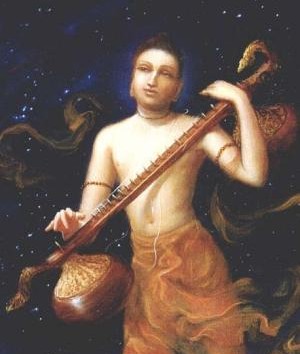
When our Vaisnava tradition was in its early days of being transplanted here in the Western world, the figure of Narada Muni was very attractive to the heady young devotees of the sixties and seventies. He is the "transcendental spaceman", flying through the cosmos, his stringed vina pulsing with the hymns of the Supreme designed to liberate the heart and soul from the chains of the body and the mind.

The attractive nature of Narada Muni is a combination of his free-spirited mode of life and his real devotion to sound. Any one of us who has either played music or listened to music with a whole-hearted fervor can understand that the sounds that thrill us, move us, inspire us, and give us shelter are treasures in our lives that we hold dearer than most anything else we can think of.

As Radhanath Swami relates, music is the most attractive and influential process of communication that we have ever known, and it is also, when used in the service of the Divine, of God, the purest and most powerful gateway to direct realization of our true, essential nature and of our relationship with the Divine.

This is Narada Muni's mission: In the vibrations of the Holy Names of the Lord that he resounds with constant enthusiasm and nectarine vigor, he provides for us the example of how best to hear and to express ourselves in this most potent medium. To chant the Holy Names, in whatever tradition one may follow, is a sublime service, a devotional offering of love from the core of our hearts that allows us to glorify God and to help others to come closer to Him.

Indeed, the essential spiritual use sound, of music, is to glorify the Divine. Indeed, it is the highest qualitative representation of sound, a quality that allows the hearer/chanter to transcend one's temporary limitations and come to his/her eternal state: as spirit soul living in a blissful, all-knowing loving relationship with the Divine.

This devotional use of music is present in all traditional spiritual cultures. Radhanath Swami shares the examples of the baroque stylings of Bach, in which his complex and beautifully surcharged compositions invoked the presence and pastimes of Christ, and which have thrived and survived through numerous centuries, as well as the traditional ragas of India, in which the scales and notes used are said in scripture to have come from the lips of God Himself.

Beyond the varied sense perceptions we experience from music, the Vedic scriptures also tell us that music, or sound itself, is responsible for creating the atmosphere around us that we live in. The sounds that we hear, and the sources of those sounds we hear from, create the favorable and unfavorable situations and experiences that we deal with in our lives.

If we want to live in a hedonistic, materialistic way, there is plenty of music we can hear to create and motivate us to line in this kind of environment, and in contrast, if we want to live in a selfless, spiritual way, there is also a whole tradition of chants, hymns, and simple, beautiful songs which can bring our soul to the surface.

A.C Bhaktivedanta Swami Prabhupada, Radhanath Swami's teacher, and the main acarya of the contemporary Vaisnava tradition, reveals the truth from his translation of the Bhagavat-Purana, or Srimad-Bhagavatam. There he writes:

"It is stated also in the Vedānta-sūtra that sound is the origin of all objects of material possession and that by sound one can also dissolve this material existence. Anāvṛttiḥ śabdāt means "liberation by sound." The entire material manifestation began from sound, and sound can also end material entanglement, if it has a particular potency. The particular sound capable of doing this is the transcendental vibration Hare Kṛṣṇa. Our entanglement in material affairs has begun from material sound. Now we must purify that sound in spiritual understanding. There is sound in the spiritual world also. If we approach that sound, then our spiritual life begins, and the other requirements for spiritual advancement can be supplied. We have to understand very clearly that sound is the beginning of the creation of all material objects for our sense gratification. Similarly, if sound is purified, our spiritual necessities also are produced from sound."

This power of music brings with it also a great responsibility. To attain a musical communion with the Divine, we must get out of the way, or in essence, we must remove any selfish or overtly egoistic motives we have for chanting or hearing the Holy Names.

In his lecture this evening, Radhanath Swami instructs that must not become distracted by the instruments or by the sounds of the instrument themselves, forgetting the sound of the Holy Name. The Holy Name must remain in the forefront, or our musical expression may fall into the mere gratification of our senses and material selfishness.

Our material musical qualifications also may become a distraction if not used properly in the service of the Holy Name; they may make us proud. We must remember that any qualifications that we have are simply gifts from God. We must simply glorify and be proud of God, chanting with great humility, in order to properly perform kirtana, or the congregational glorification of God through music.

In the bhakti-yoga tradition that Radhanath Swami is an integral part of, the chanting of the Holy Names of Krsna (Hare Krsna/Hare Krsna/Krsna Krsna/Hare Hare/Hare Rama/Hare Rama/Rama Rama/Hare Hare) is offered to us as an easy, sublime, and direct way to get in touch the with spiritual energy of the Divine.

These Holy Names of Krsna are non-different from Krsna Himself, from the Personality of the Divine. As Radhanath Swami relates to us, the Holy Name enters into our heart as a passenger on the vehicle of spiritual sound, and clears our heart of all the dust of illusion, misconception, greed, and selfishness that we desire to be free from, the shackles of material bondage, so that we can remember who we actually are, a dynamic, free, loving spirit soul.

Spiritual music is the very life force of our soul. It is said that in our original spiritual state, as we exist eternally in bliss in the spiritual world, every step is a dance and every word is a song. How we long to return to this state of being! Even if we don't know this, it is the deepest desire of our heart, always beating even under so many clouds of unnecessary material desires.

If we absorb ourselves in spiritual sound, we create the spiritual world around us, immediately, in the here and now. Let us dive deep into whatever tradition we follow, following in the example of Radhanath Swami, to find the essence of sound, the ecstasy of music, that is there for our heart's content.

Radhanath Swami is a spiritual leader, author, and public speaker. A practitioner of bhakti-yoga for almost 40 years, he helps individuals find greater inner fulfillment through devotional service. “He sees life as a continuous blessing of God’s grace,” one follower says, “and yet he never loses his humanness. His accessibility leaves people feeling that, with a little sincere effort, they too will find the path to inner peace and God realization.”

For more...
http://www.radhanathswami.com/
http://www.thejourneyhomebook.com/

http://www.radhanathmaharaj.net/

Radhanath Swami's Facebook page

His MySpace page

Friday, August 28, 2009

What Is The Matter With The World?

"WHAT IS THE MATTER WITH THE WORLD?"

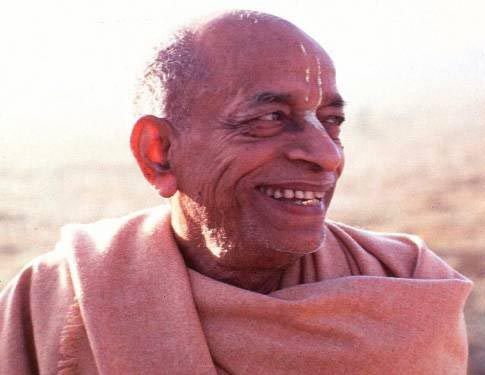
an essay by A.C Bhaktivedanta Swami Prabhupada, founder-acarya of the International Society for Krishna Consciousness

On the 16th of February 1957 a meeting was held at the Bharatiya Vidya Bhavan to discuss the above subject matter. Distinguished gentlemen from different categories spoke on the subject, but practically nobody could give us a definite direction as to what actually the matter was that was troubling the whole situation.

This feeling of pinching in the existence of our life is a good sign for progress. It is an urge for enquiry what is the wrong in the world that gives us trouble? This trouble is not a new thing but it is a matter of permanent settlement in all the days of life, but it may be felt at different times in different colour. The troubles are in varieties in relation with our mind and body, in relation with our dealings with other living beings and in relation with natural phenomenons.

The present pinching trouble of our political leaders in the matter of Kashmir affairs is a trouble in relation with our other friendly nations. Kashmir is a part of India, not only at present but it is so from a time immemorial but the Kashmir problem has arisen as a matter of course because the world is so created that must there exist some sort of trouble, may be it is in relation with the body or other living beings or the natural phenomenon.

These troubles are like the forest fire. Fire takes place in the dense forest without any attempt by any living being. Nobody in the forest do want such fire, but it takes place without any demand. When there is fire, the living beings in the forest are put into trouble and sometimes it so happens that most of the forest creatures die in that havoc. There is no fire brigade in the forest or on the top of a forest mountain and there is no hope for of extinguishing the fire by any human attempt. It takes by the natural laws, and it is extinguished by natural laws also, that is, when there is torrent of rains in the forest. That is the natural law and these laws are so rigid and stern that no human brain, however it may be powerful, can solve these problems of natural laws.

An intelligent person, who has actually developed some finer qualities of human consciousness, can understand that every law is made by an intelligent brain and behind every law there is the lawmaker who makes the law. So for all these natural laws, there is the Supreme Lawmaker, who is the Absolute Personality of Godhead. In the Bhagavad-gétä we have, therefore, information that natural laws are so stringent that they cannot be overcome by anybody. But whoever surrenders unto the Supreme Lord can overcome them.

The king is the lawmaker and if he likes he can forgive a law-breaker by special prerogative of the king—by the 'king's mercy,' but the king can do no wrong even if he sometimes breaks the law. That is, an experience of a common man in the phenomenal world and the same thing is applicable in the matter of Supreme laws also.

The natural laws are like police actions by the agents of Godhead. Men, who are too much captivated by the glamour of material beauty and tries to enjoy it falsely without acknowledgement of its Creator, are called demons. The stringent natural laws are meant for the criminals but not for the law-abiders. Therefore, the perfect answer to the question "What is the matter with the world?" is that men have become demons by breaking laws of God, and therefore they are being punished by the police action of material nature. That is the verdict of all scriptures and that is our day-to-day life's experience.

In the Bhagavad-gitä a vivid description of the law-breaker demoniac men are given in the 16th chapter and such men are punished by the laws of God—are also maintained.
Human civilizations are conducted in two ways. One type of civilization can make every human being as much qualified as God is. And the other type of civilization can make every man no less than a jungle beast and thereby making this world unfit for human habitation.

A human being is called a rational animal. When rationality is destroyed, the human being is left an ordinary animal. The difference between a human being and an animal is based on the strength of human being's being above the animal propensities. The animal part of a human being necessarily require food to eat, shelter to live in, protection from fear and gratification of senses. These four principles of life are common both to the man and the animals. But there is another thing which is specially meant for the human being. This is God-consciousness. This God-consciousness is conspicuous by absence in the animal life, while in the human life this God-consciousness is in dormant stage even in the society of the aborigines.

This God-consciousness develops in different grades of human civilization in terms of particular place, time and persons. This God-consciousness is called Religion or Culture of Life without which no civilization can stand.

The present day civilization is trying to avoid this God-consciousness of human life by artificial method of material science and forcible atheism. It is learnt from reliable sources that in an atheistic state, the village people were called in a meeting and were asked to pray in the church for daily bread. The innocent villagers prayed in the church for daily bread, and when the prayer was over the state officers asked them whether breads were supplied. The village men replied that there was no bread. The atheist politicians asked them again to pray for bread from them (the statesmen) and bread was at once supplied. And by this method the innocent villagers were made victims of propaganda by atheistic politicians with the result that all the villagers became gradually faithless in God, because wrongly they accepted that the bread was supplied by the politicians and not by God.

The poor victims of such propaganda did not understand that the breads supplied by the politicians were not made by the father of the politicians but actually they were sent by God. No politician can manufacture bread without wheat. No wheat is produced without sun rays or rains from the sky. No rains are possible without obedience to God. No atheist can live and decry God without eating bread. And therefore whoever eats bread without acknowledging in gratitude of his indebtedness to God is certainly a demon and for such demons the stringent natural laws are meant for punishment. A time is nearing when there will be no wheat paddy in the field and no politician will be able to make a quick supply of bread. The food problem is already acute.

The atheistic civilization is to be troubled more and more with the progress of materialism. We have such foretellings in the pages of Srimad-Bhägavatam. The more the people are turning to the atheistic, the more things of disturbing elements do appear before us. And that is the thing which matters at present. This is a wrong type of civilization.