Tuesday, March 23, 2010

Chewing The Chewed? Texts Without Context

A interesting and somewhat disconcerting article about the effects of contemporary expressions of media on our already fractured and conditioned consciousness, and how we are participating in what may end up being a collective cultural "movement" bearing very dull and mundane fruit.
It's something we as monks trying to reach out to young people certainly notice in our humble efforts to communicate something deeper. Our friends out there in the subway platforms and universities have a real devotion to one's subjective experience, or a real aversion to commitment to a discipline and concrete path.

Something like the "regulative principles of freedom" don't make much sense to them. They say: "Why should I limit myself? There's so much to dabble in, so much to learn." True enough, true enough. But my experience tells me that the clarity they, and we, all seek comes from seeing a larger picture, a clearer picture, and from making a educated and willing choice to commit our lives to the tangible word of God, of Krsna.

Sure, this isn't anything new. But this article jolts me into an understanding that our work to reveal Krsna to the hearts of our friends gets trickier and trickier. What do you think?

Click here to read the full article from the New York Times

"Given the constant bombardment of trivia and data that we’re subjected to in today’s mediascape, it’s little wonder that noisy, Manichean arguments tend to get more attention than subtle, policy-heavy ones; that funny, snarky or willfully provocative assertions often gain more traction than earnest, measured ones; and that loud, entertaining or controversial personalities tend to get the most ink and airtime. This is why Sarah Palin’s every move and pronouncement is followed by television news, talk-show hosts and pundits of every political persuasion. This is why Glenn Beck and Rush Limbaugh on the right and Michael Moore on the left are repeatedly quoted by followers and opponents. This is why a gathering of 600 people for last month’s national Tea Party convention in Nashville received a disproportionate amount of coverage from both the mainstream news media and the blogosphere.

Digital insiders like Mr. Lanier and Paulina Borsook, the author of the book “Cyberselfish,” have noted the easily distracted, adolescent quality of much of cyberculture. Ms. Borsook describes tech-heads as having “an angry adolescent view of all authority as the Pig Parent,” writing that even older digerati want to think of themselves as “having an Inner Bike Messenger.”

For his part Mr. Lanier says that because the Internet is a kind of “pseudoworld” without the qualities of a physical world, it encourages the Peter Pan fantasy of being an entitled child forever, without the responsibilities of adulthood. While this has the virtues of playfulness and optimism, he argues, it can also devolve into a “Lord of the Flies”-like nastiness, with lots of “bullying, voracious irritability and selfishness” — qualities enhanced, he says, by the anonymity, peer pressure and mob rule that thrive online."

Thursday, March 11, 2010

Mass-Market Epiphany


Published: March 7, 2010 in the New York Times

Mysticism is dying, and taking true religion with it. Monasteries have dwindled. Contemplative orders have declined. Our religious leaders no longer preach the renunciation of the world; our culture scoffs at the idea. The closest most Americans come to real asceticism is giving up chocolate, cappuccinos, or (in my own not-quite-Francis-of-Assisi case) meat for lunch for Lent.

This, at least, is the stern message of Luke Timothy Johnson, writing in the latest issue of the Catholic journal Commonweal. As society has become steadily more materialistic, Johnson declares, our churches have followed suit, giving up on the ascetic and ecstatic aspects of religion and emphasizing only the more worldly expressions of faith. Conservative believers fixate on the culture wars, religious liberals preach social justice, and neither leaves room for what should be a central focus of religion — the quest for the numinous, the pursuit of the unnamable, the tremor of bliss and the dark night of the soul.

Yet by some measures, mysticism’s place in contemporary religious life looks more secure than ever. Our opinion polls suggest that we’re encountering the divine all over the place. In 1962, after a decade-long boom in church attendance and public religiosity, Gallup found that just 22 percent of Americans reported having what they termed “a religious or mystical experience.” Flash forward to 2009, in a supposedly more secular United States, and that number had climbed to nearly 50 percent.

In a sense, Americans seem to have done with mysticism what we’ve done with every other kind of human experience: We’ve democratized it, diversified it, and taken it mass market. No previous society has offered seekers so many different ways to chase after nirvana, so many different paths to unity with God or Gaia or Whomever. A would-be mystic can attend a Pentecostal healing service one day and a class on Buddhism the next, dabble in Kabbalah in February and experiment with crystals in March, practice yoga every morning and spend weekends at an Eastern Orthodox retreat center. Sufi prayer techniques, Eucharistic adoration, peyote, tantric sex — name your preferred path to spiritual epiphany, and it’s probably on the table.

This democratization has been in many ways a blessing. Our horizons have been broadened, our religious resources have expanded, and we’ve even recovered spiritual practices that seemed to have died out long ago. The unexpected revival of glossolalia (speaking in tongues, that is), the oldest and strangest form of Christian worship, remains one of the more remarkable stories of 20th-century religion.

And yet Johnson may be right that something important is being lost as well. By making mysticism more democratic, we’ve also made it more bourgeois, more comfortable, and more dilettantish. It’s become something we pursue as a complement to an upwardly mobile existence, rather than a radical alternative to the ladder of success. Going to yoga classes isn’t the same thing as becoming a yogi; spending a week in a retreat center doesn’t make me Thomas Merton or Thérèse of Lisieux. Our kind of mysticism is more likely to be a pleasant hobby than a transformative vocation.

What’s more, it’s possible that our horizons have become too broad, and that real spiritual breakthroughs require a kind of narrowing — the decision to pick a path and stick with it, rather than hopscotching around in search of a synthesis that “works for me.” The great mystics of the past were often committed to a particular tradition and community, and bound by the rules (and often the physical confines) of a specific religious institution. Without these kind of strictures and commitments, Johnson argues, mysticism drifts easily into a kind of solipsism: “Kabbalism apart from Torah-observance is playacting; Sufism disconnected from Shariah is vague theosophy; and Christian mysticism that finds no center in the Eucharist or the Passion of Christ drifts into a form of self-grooming.”

Most religious believers will never be great mystics, of course, and the American way of faith is kinder than many earlier eras to those of us who won’t. But maybe it’s become too kind, and too accommodating. Even ordinary belief — the kind that seeks epiphanies between deadlines, and struggles even with the meager self-discipline required to get through Lent — depends on extraordinary examples, whether they’re embedded in our communities or cloistered in the great silence of a monastery. Without them, faith can become just another form of worldliness, therapeutic rather than transcendent, and shorn of any claim to stand in judgment over our everyday choices and concerns.

Without them, too, we give up on what’s supposed to be the deep promise of religious practice: that at any time, in any place, it’s possible to encounter the divine, the revolutionary and the impossible — and have your life completely shattered and remade.

Sunday, March 7, 2010

No Time: A Disease Of The Common Man

In Union Square, Manhattan, on your average sankirtana afternoon, they rush and swoop and meander by, all shapes and colors and demeanor, all in a rush to be somewhere, perhaps to be nowhere.

"Excuse me sir, we're showing this wonderful book of spiritual wisdom, the Bhagavad-Gita....Sorry, I've got no time...I'm in a rush" Some mean it and apologize. Some walk by me at approximately .32 mph and say it, and I have to restrain myself to not point out their obvious lie to me.

It's certainly bewildering, and hopefully a little inspiring to help us knights of faith to keep on keeping on to find those not rushing into one abyss after another.

In the March 16, 1956 edition of Back To Godhead, Srila Prabhupada shares his own sankirtana observations of those with "no time."

No Time: A chronic disease of the common man

When we approach some gentleman and request him to become a reader of "Back to Godhead" sometimes we are replied with the words "NO TIME".

They say that they are too busy in earning money for maintaining the body and soul together.

But when we ask them what do they mean by the 'Soul', they have nothing to reply.

Dr. Meghnath Saha a great scientist was busily going to a meeting of the Planning Commission. Unfortunately while going in his car on the road he died and could not ask Death to wait because he had no time at that moment.

Dr. Ansari, the great Congress leader, while dying in a moving train, on his way to home, said that he was himself a medical man and almost all his family men were so, but Death is so cruel that he was dying without any medical treatment.

Therefore, Death has been described in the Bhagwat as (In Devanagari:) "durantavirya" or the indefatigable. Death is awaiting everyone although everybody thinks that he may not die. There is life after death. The busy man should try to know this also as to whither he is going.

This life is but a spot in his longest sojourn and a sane person should not be busy with a spot only. Nobody says that the body should not be maintained-but every body should know from "Bhagwat Geeta", that the body is the outward dress and the 'Soul' is the real person who puts on the dress. So if the dress is taken care of only, without any care of the real person-it is sheer foolishness and waste of time.

When God is served, everything is served. Because God is everything, but everything is not God. When something is served, everything is not served for something is not everything. It is something like pouring water at the root of the tree or filling the stomach with foodstuff. That is the standard of service.

In the 'Bhagwata Geeta' Shri Krishna said (Bg. 7.13-14):
"All the world is enchanted by the three modes of natural qualities and thus they don't know Me, behind all these phenomenon, who am the Supreme ever-existing Lord." "All these illusions are certainly amusing or transcendental and they are insurmountable also. But those who serve Me only-can overcome all these."

Nobody can go "Back to Godhead" or know Him as the Supreme Personality, because everyone is under the grip of the qualitative material nature. The material nature as she has three modes of qualities namely, goodness, passion and ignorance, even the highest intelligent person who may have possessed all the mundane good qualities, down to the lowest mass of people, mostly uneducated, lazy and overwhelmed with immense varieties of anxieties, none of them can know the Lord for the above reason.

The natural laws are so made that they appear before us as so many problems. They are stiff because of the three qualities. The qualities are said to be amusing because everyone is satisfied by the quality of his sense-enjoyment.

Beginning from the highest civilized man (a type of living being) down to the stool-eater Swine (another type of living being) everyone is satisfied by the object of sense gratification, even though they are all of different qualities.

A learned Brahmin who is said to be the highest qualitative living being in the mode of goodness, down to the dog or the dog-eater man, who is considered to be the lowest qualitative living being, everyone is captivated by his own qualitative nature. And as long as one is conditioned by different modes of nature one cannot know the Supreme Person the cause of all causes.

All of them are imprisoned by the different modes of qualitative shackles, one is bound up by the shackles of gold while the other is bound up by the shackles of iron.
The material nature is so powerful, that she can keep under her conditions, all such illusioned living being in different categories of material modes. As the prisoner cannot himself break the shackles by his own effort so also nobody can surmount the laws of nature by his own tiny effort.

No amount of plans either of five, ten, or thousands and millions of years can therefore bring in permanent happiness to us, unless and until we take up the plan of the Supreme Lord and execute it sincerely. That is called the Standard Service.
It is therefore essential that we should all take up immediately, the execution of the plan of Shri Krishna the Personality of Godhead by our standard service as chalked out in the lessons of "Bhagwat Geeta."

The wrong type of civilization, which is too much materialistic, is dragging the total population of the world gradually towards a fall down into the lowest status of conditioned life. Conditioned life means to be more and more entangled by the laws of physical nature. The function of the physical nature is explained above. And those who are too much enamored by such physical laws are called the Ashuras or the Atheist. The Atheist does not like to accept the Standard service which is recommended by the Supreme authority of the Personality of Godhead.

Such atheists, however they may be great religionists, scholars, scientists, politicians, philosophers, poets, artists, administrators, businessmen, lawyers, educationists etc., are befooled by the laws of nature and therefore they do not recognize the Supreme authority of the All-Powerful.

Wednesday, February 24, 2010

The Nectar Chronicles: Part 14

How can we ever fathom his love? He came across many seas, with so many ideas, and because of the sincerity and reality of his understanding, he saw very easily through our disqualifications and saw only the pure essence of what we could potentially give?

How can we ever fathom his vision? He, who is the greatest revolutionary, the greatest prophet, and our greatest friend, who was not beholden to cultural customs of discrimination, who out of the depths of his own heart, simply came to help us understand our own depths, and to meet the Person who lives there.

How can we ever fathom his sacrifice? It is something none of us can ever imitate. So I simply pray to you Srila Prabhupada. I pray to you to somehow fathom just a drop of your love for me, and I pray for the constant opportunity to return that love, although I will never be able to do so in full.

But you are so patient, tolerant, and accepting of any offering I may make....

***
Our material lives are simply a chain of suffering. As we mature in our spiritual lives, we come to a truth that hurts. It's a truth that with every propensity and action we have against the will and desire of Krsna, we shape another material body in this chain.

This is a truth which flies against all the reasoning of our material conditioning, which offers a stinging challenge to the enjoying spirit we hold dear. In our spiritual maturity, it is a challenge that we do not shy away from, but that we face face-to-face and give all that we can to overcome.

The art of punya-karma, the art of devotional service, is the everyday miracle of courage and strength that gives us the ability to overcome this challenge. Its main facet and potency comes through our hearing the words of Krsna and His devotees, which produce three effects: We develop actual knowledge, we develop actual renunciation, and we develop actual immunity from the effects of our sinful life.

This is a most personal development of realizations and experiences, buoyed by the most personal of exchanges, between ourselves and the Lord. Prabhupada writes in his purport to Srimad Bhagavatam 1.2.17:

"The Lord is reciprocally respondent to His devotees. When He sees that a devotee is completely sincere in getting admittance to the transcendental service of the Lord and has thus become eager to hear about Him, the Lord acts from within the devotee in such a way that the devotee may easily go back to Him.

The Lord is more anxious to take us back into His kingdom than we can desire. Most of us do not desire at all to go back to Godhead. Only a very few men want to go back to Godhead. But anyone who desires to go back to Godhead, Sri Krsna helps in all respects."


This is one of the main barometers of our spiritual progress. How much are we actually feeling this personal reciprocation from Krsna? How much do we realize that He is a Person, our Best Friend, and how much do we understand his helping presence in our lives?

Two inches of rope. His mercy and our effort. One of the most fundamental levels, yet of course one of the most difficult, is to give up our gross sinful habits. Prabhupada knew very acutely that the young disciples in front of him in the courtyard of the samadhi of Rupa Goswami on this evening were walking a tightrope, that maya's grip was still very much imperative.

Therefore he implored:

"Once we take to Krsna consciousness, we should stop the pillars of sinful activities. Whatever we did in our past life, that is excused, but if we take to Krsna consciousness, and if we go on with our sinful activities, that will not help us. Just like the same fire: you take the fuel and add to the fire, it will burn into ashes. But, at the same time, if you pour some water also, then it will be useless. Similarly, our past sinful activities, that can be burned into ashes provided we don't add any more."

It's easy to see on a somber evening in Manhattan, amidst imposing facades of concrete and poor, lost souls yelling at themselves and to no one in particular, that this material world is place of the most heavy darkness.

Prabhupada stands before us, beckoning, for us to turn to the light of our original nature, our original connection. This is a light which illuminates our whole being, and again, this is a great challenge, for in that illumination we see all that is impure, all that is false, all that we cling to with hopeless fervor.

But in turning towards that brightest of lights, we get a chance to slay our greatest enemy. Prabhupada reveals:

"And this ignorance is our greatest enemy. The human form of life is meant for acquiring knowledge, not to keep one in ignorance. Tamasi ma jyotir gamah. That is the Vedic injunction. "Don't keep yourself in darkness," darkness of ignorance. But jyotir gamah: "Go to the light." That is the Vedic injunction."

Krsna is the very source of this illuminated knowledge, leading us to His most personal loving exchange. This knowledge cannot come, no matter how hard we try, from our own imperfect senses, and from our own imperfect extensions of those senses, namely our earthbound philosophies and theories, nor from our expensive telescopes and microscopes.

Prabhupada reasons:

"A human being cannot give us any perfect knowledge. Therefore all the scientists' statements, all the philosophers' statements, they are simply theories; they are not fact. Because the knowledge is not perfect. Perfect knowledge can be had from one who is not defective. Defective means generally a conditioned soul has four defects: he commits mistake, he is illusioned, he has got a cheating propensity, and his senses are imperfect.

The senses, we are acquiring knowledge through our senses, and if our senses are imperfect, how we can acquire perfect knowledge? Just like we are trying to see the planetary system through microscope or binocular, telescope, but the telescope machine is manufactured by a person who is, whose senses are defective. So through the telescope, how you can have perfect knowledge?"


We want to perfect our pesky knowledge faculties, which so easily lead us astray down the highways of meaningless. When we link ourselves up to the parampara, in a heart-filled connection which one can even experience through this keyboard, through this hyperspace, we find the natural way.

Prabhupada defines this connection as such:

"One has to accept a guru, a spiritual master, who has received knowledge from another perfect spiritual master. Just like Krsna is the origin, perfect spiritual master, guru. So Krsna, what Krsna said, was realized by Arjuna, directly. Therefore if we receive knowledge from Arjuna or his disciplic succession, then our knowledge is perfect. Krsna..., Arjuna accepted Krsna as the Supreme Brahman: param brahma param dhama pavitram paramam bhavan [Bg. 10.12].

So if we accept the version of Arjuna, that Krsna is Param Brahman, He's the Supreme Person, He's the origin of everything, then our knowledge is perfect. I may be imperfect, but because I receive knowledge from a perfect person, my knowledge is perfect. This is called parampara system."


This natural way helps us to finally and forever give up our God-project, to cure ourselves of this perpetual fever that robs of the birthright of our own vitality. Prabhupada says:

"Liberated means, as I have several times explained, to be situated in his original position. Just like a, a person gets fever. When his fever is subsided, he's liberated, he's called liberated from the fever. Similarly, when we have perfect knowledge... What is that perfect knowledge? The perfect knowledge: to understand that "I am eternal servant of Krsna." This is perfect knowledge. This is perfect knowledge. Jivera svarupa haya nityera krsnera dasa [Cc. Madhya 20.108]. One has to understand this fact, that "I am not Krsna. I am not like Krsna. I am not equal to Krsna. I cannot become Krsna. I am Krsna's eternal servant."

Our fidelity and chastity to the parampara is also an essential element. In this, we follow the very lotus footprints of Krsna Himself, for as Prabhupada reveals, He also never made it a point to stray from the sastra:

"They are thinking if they can manufacture some new line, adding with Hare Krsna, then he becomes particularly noted. But he spoils the whole thing. That is the... He does not make any new thing. The new thing he does, he spoils the whole thing. So Caitanya Mahaprabhu never did so, although He's Krsna Himself. He stuck to the point of sastra.

Krsna, He is the Supreme Personality of Godhead.
He also indicates: yah sastra- vidhim utsrjya vartate kama-karatah na siddhim savapnoti [Bg. 16.23]. He indicates that nobody can give up the injunction of the sastra. Brahma-sutra-padais caiva hetumadbhir viniscitaih [Bg. 13.5]. Krsna says. He can give. Whatever He says, that is sastra, that is Veda. But still, He gives reference to the sastra."

***
We cannot understand the true meaning of the word liberal until we understand Prabhupada's own liberal vision, which has given each and every one of us a chance to understand love of God.

The most degraded of backgrounds is no disqualification. As we stand like Jagai and Madhai before the Lord, Prabhupada, in the exact mood of Lord Nityananda, begs for us to be given a chance, to show our true colors. He says this evening in Vrndavana:

"In these parts of the world, the Koreans, the Philippines, even the Chinese, some of the Japanese, they're dog-eaters. But even though they are dog-eaters, they attended the meeting and chanted with us so nicely, better than a so-called Vaisnava in India. Yes. They were so nice. It is practically seen. So that is also stated in the, confirmed in the Bhagavad-gita. Svado 'pi sadyah savanaya kalpate.

If one dog-eater, a person born in the family of dog-eaters... Because the dog-eaters are considered lowest of the human kind, candala, sva-paca. In many places it is said. Aho bata svapaco 'pi gariyan yaj-jihvagre nama tubhyam. Sva- paca. Svapaca means dog-eaters. They also become glorious provided they chant offenselessly the Hare Krsna mantra."


Who can fathom his liberal mercy? Let us all pray to Prabhupada to give our whole lives to simply return his favor upon us.

Thursday, February 18, 2010

Merton's Gita intro

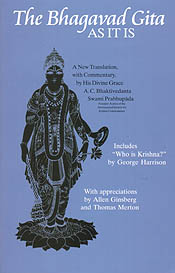
Christian scholar, teacher, monk, and mystic Thomas Merton's introduction to original Macmillan printing of Srila Prabhupada's Bhagavad-Gita As It Is,

The word Gita means "Song." Just as in the Bible the Song of Solomon has traditionally been known as "The Song of Songs" because it was interpreted to symbolize the ultimate union of Israel with God (in terms of human married love), so The Bhagavad Gita is, for Hinduism, the great and unsurpassed Song that finds the secret of human life in the unquestioning surrender to and awareness of Krishna.

While The Vedas provide Hinduism with its basic ideas of cult and sacrifice and The Upanishads develop its metaphysic of contemplation, The Bhagavad Gita can be seen as the great treatise on the "Active Life." But it is really something more, for it tends to fuse worship, action and contemplation in a fulfillment of daily duty which transcends all three by virtue of a higher consciousness: a consciousness of acting passively, of being an obedient instrument of a transcendent will.

The Vedas, The Upanishads, and The Gita can be seen as the main literary supports for the great religious civilization of India, the oldest surviving culture in the world. The fact that The Gita remains utterly vital today can be judged by the way such great reformers as Mohandas Gandhi and Vinoba Bhave both spontaneously based their lives and actions on it, and indeed commented on it in detail for their disciples. The present translation and commentary is another manifestation of the permanent living importance of The Gita.

Swami Bhaktivedanta brings to the West a salutary reminder that our highly activistic and one-sided culture is faced with a crisis that may end in self-destruction because it lacks the inner depth of an authentic metaphysical consciousness. Without such depth, our moral and political protestations are just so much verbiage. If, in the West, God can no longer be experienced as other than "dead," it is because of an inner split and self-alienation which have characterized the Western mind in its single-minded dedication to only half of life: that which is exterior, objective, and quantitative.

The "death of God" and the consequent death of genuine moral sense, respect for life, for humanity, for value, has expressed the death of an inner subjective quality of life: a quality which in the traditional religions was experienced in terms of God-consciousness. Not concentration on an idea or concept of God, still less on an image of God, but a sense of presence, of an ultimate ground of reality and meaning, from which life and love could spontaneously flower.

Realization of the Supreme "Player" whose "Play" (Lila) is manifested in the million-formed, inexhaustible richness of beings and events, is what gives us the key to the meaning of life. Once we live in awareness of the cosmic dance and move in time with the Dancer, our life attains its true dimension.

It is at once more serious and less serious than the life of one who does not sense this inner cosmic dynamism. To live without this illuminated consciousness is to live as a beast of burden, carrying one's life with tragic seriousness as a huge, incomprehensible weight (see Camus' interpretation of the Myth of Sisyphus). The weight of the burden is the seriousness with which one takes one's own individual and separate self. To live with the true consciousness of life centered in Another is to lose one's self-important seriousness and thus to live life as "play" in union with a Cosmic Player.

It is He alone that one takes seriously. But to take Him seriously is to find joy and spontaneity in everything, for everything is gift and grace. In other words, to live selfishly is to bear life as an intolerable burden. To live selflessly is to live in joy, realizing by experience that life itself is love and gift. To be a lover and a giver is to be a channel through which the Supreme Giver manifests His love in the world.

But The Gita presents a problem to some who read it in the present context of violence and war which mark the crisis of the West. The Gita appears to accept and to justify war. Arjuna is exhorted to submit his will to Krishna by going to war against his enemies, who are also his own kin, because war is his duty as a Prince and warrior. Here we are uneasily reminded of the fact that in Hinduism as well as in Judaism, Islam, and Christianity, there is a concept of a "Holy War" which is "willed by God" and we are furthermore reminded of the fact that, historically, this concept has been secularized and inflated beyond measure.

It has now "escalated" to the point where slaughter, violence, revolution, the annihilation of enemies, the extermination of entire populations and even genocide have become a way of life. There is hardly a nation on earth today that is not to some extent committed to a philosophy or to a mystique of violence. One way or other, whether on the left or on the right, whether in defense of a bloated establishment or of an improvised guerrilla government in the jungle, whether in terms of a police state or in terms of a ghetto revolution, the human race is polarizing itself into camps armed with everything from Molotov cocktails to the most sophisticated technological instruments of death.

At such a time, the doctrine that "war is the will of God" can be disastrous if it is not handled with extreme care. For everyone seems in practice to be thinking along some such lines, with the exception of a few sensitive and well-meaning souls (mostly the kind of people who will read this book).

The Gita is not a justification of war, nor does it propound a war-making mystique. War is accepted in the context of a particular kind of ancient culture in which it could be and was subject to all kinds of limitations. (It is instructive to compare the severe religious limitations on war in the Christian Middle Ages with the subsequent development of war by nation states in modern times-backed of course by the religious establishment. )

Arjuna has an instinctive repugnance for war, and that is the chief reason why war is chosen as the example of the most repellent kind of duty. The Gita is saying that even in what appears to be most "unspiritual" one can act with pure intentions and thus be guided by Krishna consciousness. This consciousness itself will impose the most strict limitations on one's use of violence because that use will not be directed by one's own selfish interests, still less by cruelty, sadism, and mere blood lust.

The discoveries of Freud and others in modern times have, of course, alerted us to the fact that there are certain imperatives of culture and of conscience which appear pure on the surface and are in fact bestial in their roots. The greatest inhumanities have been perpetrated in the name of "humanity," "civilization," "progress," "freedom," "my country," and of course "God."

This reminds us that in the cultivation of an inner spiritual consciousness there is a perpetual danger of self-deception, narcissism, self-righteous evasion of truth. In other words the standard temptation of religious and spiritually minded people is to cultivate an inner sense of rightness or of peace, and make this subjective feeling the final test of everything. As long as this feeling of rightness remains with them, they will do anything under the sun. But this inner feeling (as Auschwitz and the Eichmann case have shown) can coexist with the ultimate in human corruption.

The hazard of the spiritual quest is of course that its genuineness cannot be left to our own isolated subjective judgment alone. The fact that I am turned on doesn't prove anything whatever. (Nor does the fact that I am turned off.) We do not simply create our own lives on our own terms. Any attempt to do so is ultimately an affirmation of our individual self as ultimate and supreme. This is a self-idolatry which is diametrically opposed to "Krishna consciousness" or to any other authentic form of religious or metaphysical consciousness.

The Gita sees that the basic problem of man is his endemic refusal to live by a will other than his own. For in striving to live entirely by his own individual will, instead of becoming free, man is enslaved by forces even more exterior and more delusory than his own transient fancies.

He projects himself out of the present into the future. He tries to make for himself a future that accords with his own fantasy, and thereby escape from a present reality which he does not fully accept. And yet, when he moves into the future he wanted to create for himself, it becomes a present that is once again repugnant to him. And yet this is precisely what he has "made" for himself-it is his own karma.

In accepting the present in all its reality as something to be dealt with precisely as it is, man comes to grips at once with his karma and with a providential will which, ultimately, is more his own than what he currently experiences, on a superficial level, as "his own will." It is in surrendering a false and illusory liberty on the superficial level that man unites himself with the inner ground of reality and freedom in himself which is the will of God, of Krishna, of Providence, of Tao.

These concepts do not all exactly coincide, but they have much in common. It is by remaining open to an infinite number of unexpected possibilities which transcend his own imagination and capacity to plan that man really fulfills his own need for freedom. The Gita, like the Gospels, teaches us to live in awareness of an inner truth that exceeds the grasp of our thought and cannot be subject to our own control. In following mere appetite for power, we are slaves of our own appetite. In obedience to that inner truth we are at last free.