Tuesday, June 23, 2009

A Righteous Escape

From the Sunday, June 21st edition of the New York Times

The government limits the number of monks allowed to live in the monastery, they said. Officials cracked down on festivities honoring the Dalai Lama. When the Chinese-appointed Panchen Lama visited Labrang several years ago, monks were forced to stay indoors to prevent disturbances.

Last year, when monks in Lhasa, the Tibetan capital, began leading peaceful protests on March 10, word spread quickly to Labrang.

Thousands of monks and lay people in Xiahe marched to government offices demanding the return of the Dalai Lama. Some protesters broke into buildings and threw stones at riot police officers.

From then on, the government tightened the screws on the monastery, the monks said. A curfew was imposed. Security officers arrested several monks each night. The monastery began to empty out.

“Some monks ran off to their homes in the countryside,” said Jamyang Jinpa, 24.

The authorities began holding daily hourlong patriotic education classes, in which the monks were forced to read tracts denouncing the Dalai Lama and pledge loyalty to the Communist Party.

“As a Buddhist monk who believes in the Dalai Lama as our foundation, it was unbearable to read this,” Lobsang said.

On the night of April 8, some monks heard on the radio that foreign journalists were to arrive in Labrang the next day on a government tour.

“We immediately stopped what we were doing that night and started discussing the protest,” Jamyang said.

A half-dozen monks brought out a Tibetan flag and scrawled slogans on three white banners. “We have no freedom of speech,” read one. They wrote their wills on the back of the flag because they thought there was a good chance they would be killed by Chinese security forces, Jamyang said.

When they went to the main temple the next morning, they were struck by a strange sight: Hundreds of people were milling about the square outside. Most were plainclothes Chinese security officers.

“We knew then that the journalists were coming,” Jamyang said. “We pretended to visit the temple.”

When the journalists and their government escorts pulled up in minivans, the monks dashed across the square, unfurling their flag and banners. A few words were exchanged in Chinese. Some monks draped white ceremonial scarves around the necks of several journalists.

“The Chinese people in plainclothes took photos of us, but they dared not stop us in front of the journalists,” Jamyang said.

That night, security officers searched the cells of the monks involved in the protest, but the monks had hidden elsewhere. The next night, Jamyang slipped into the mountains and kept walking until dawn.

“After the protest, I felt I would be arrested at any time,” he said.

Jamyang spent the first two months mostly sleeping outdoors, he said, sometimes in ditches that he had dug himself. He tossed away his red robes and began growing out his hair. In the summer, he wandered to the high pastures and slept in the tents of nomads.

“In my dreams, sometimes I would see myself getting shot and dying,” he said.

Two other monks from the protest, Lobsang and Jigme Gyatso, also fled the monastery in the days after Jamyang left. The three stayed apart. After nearly a year in hiding, the monks learned of a guide in Lhasa who could smuggle them into Nepal.

Using fake identification cards, they boarded the new high-altitude train to Lhasa. A driver then sneaked them past checkpoints to the Nepal border, where they crossed a river on logs.

Of the 15 monks who took part in that protest in front of the journalists, only these three have escaped to India. That they made it here is considered extraordinary given how tightly Chinese authorities clamped down on Tibet. The refugee center here usually gets 2,500 to 3,000 Tibetans per year, but that dropped to 550 last year. By the end of May, only 176 refugees had arrived, said Ngawang Norbu, the center’s director.

The monks say they have no regrets about holding the protest — to them, there was no other way to show the world their true feelings about Chinese rule.

“I miss my friends and family in Tibet, but I try to bury my feelings,” Jamyang said. “At the moment, I can’t return to Tibet, and I don’t know about the future.”

Thursday, June 18, 2009

The Nectar Chronicles: Part 1

Inspired by the "Nectar of Devotion" lecture series given by His Divine Grace Srila Prabhupada from October 20-November 13, 1972 at the Radha-Damodara Temple in Vrndavana, India

All of these lectures are available for download at ISKCON Desire Tree.

Let me set the scene...

It is autumn in Vrndavana. The clouds have broken in the rainy season, a natural metaphor of the mercy of Caitanya Mahaprabhu that has broken through to the Western world.

Prabhupada describes it thusly in the "The Description of Autumn" chapter of Krsna book: "As clouds sometimes clear, even in the rainy season, and sometimes the moon, stars and sun become visible, so even in this Kali-yuga there are sometimes advantages. For example, sometimes Lord Caitanya’s Vedic movement of distributing the chanting of the Hare Krsna mantra is heard. People seriously eager to find real light should take advantage of this movement instead of looking toward the light of mental speculators and atheists."

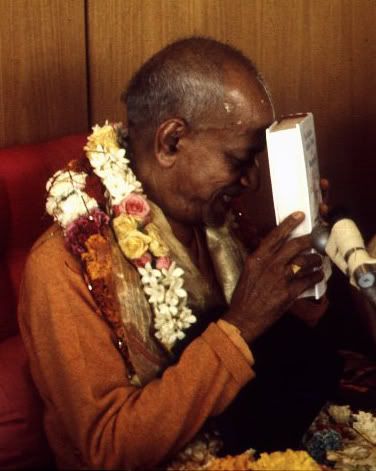
Surrounded by a transcendental gaggle of his young, eager,confused, and very sincere disciples from the mleccha-lands, the acarya, the best friend, the magnificent personality that is Srila Prabhupada expounds on the basics of Krsna Consciousness, laying the literal foundation for the worldwide spreading of his mission for the benefit of all living entities.

Thanks to the minor miracles of modern recording technology, we, as his disciples and grand-disciples and so on, have the unique situation of having the sound of the acarya, the words of the acarya, and the presence of the acarya available freely at our fingertips and eardrums at any given moment.

These are my humble reflections on these timeless and priceless lectures, the words of Srila Prabhupada, the parampara passing through him and in him, to us now and forever.

Lecture #1
10-20-72


Srila Prabhupada knows that his young disciples, those his spiritual master has sent to him to help him fulfill his mission, are raw and prone to easy and heavy misjudgement and misunderstanding.

So, although he is speaking from the very exalted platform of the Bhakti-Rasamrta-Sindhu by Srila Rupa Goswami, which has been translated by Prabhupada, who like Srila Vyasadeva is very kind to the ignorant masses, into The Nectar of Devotion, we are really here in Krishna Consciousness 101, and we should relish every moment.

This is our chance to stand on the firmest ground, to build the strongest foundation, simply by our attentive and respectful hearing.

Rupanugas
...Who is the personality behind this foundation? It is Srila Rupa Goswami. Prabhupada says our aim of life must be to serve the mission of the acaryas. By this service, in its many dynamic forms and expressions, we actually associate with Rupa Goswami and all the acaryas personally

Another brick in the transcendental wall of our foundation is the association of the devotees, the cypher and medium through which we gain the opportunity for loving service exchanges wherein this personal association of the acaryas lies, waiting to bear its fruit.

Siddhanta...the conclusions of the acaryas are the lighthouse of clarity in the dark sea of the Kali-Yuga. Prabhupada says to the assembled Vaisnavas:

"Those who are advanced devotee, they know siddhänta, the conclusion. In the Caitanya-caritämåta, therefore, it has been advised, siddhänta baliyä citte nä kara alasa ihä haite krsna läge sudrdha mänasa [Ädi 2.117]

If you neglect siddhänta, conclusion, given by the äcäryas, then you will misunderstand Krsna. Krsna, therefore Narottama däsa Thäkura says... These are the evidences.
Narottama däsa Thäkura, such an exalted äcärya, he's teaching us, "Don't try to understand yugala-piriti, the love affairs between Rädhä and Krsna, concoctedly, by your own concoction." No.

You should first of all try to serve the Six Gosvämis, rüpa-raghunätha-pade haibe äkuti, how they are directing. Just like this Bhakti-rasämåta-sindhu. Srila Rüpa Gosvämi is not teaching in the beginning the loving affairs of Rädhä-Krsna. No. He's training, first of all, the reader, the devotee, how to become first of all pure devotee."


If we jump, we shall fall...fall right off the cliff. Prabhupada warns his young disciples, he warns us, that we shouldn't take off the training wheels until we know how to balance ourselves, until we know how to ride the bike of Vaisnava etiquette, until we have real, honest, active faith in the siddhanta of the acaryas.

We cannot re-establish our relationship with Krsna artificially, or as Prabhupada reveals by metaphor, we cannot force the sun to rise. It is revealed gradually, with proper training. Svarup-siddhi, our natural position, is revealed gradually.

Prabhupada also knows that some of his young disciples are still impressionable to the impersonalist gobbly-gook they discovered in their psychedelic journey to the promised land.

Similar to the "stay high forever" rhetoric of the 2nd Avenue days, Prabhupada relates that the impersonalist may shoot into the effulgence like a rocket, buoyed by his austerities, but like the rocket, unless it finds a planet to land on and engage, one cannot float forever. One must come back down.

Whether its psychedelic seasoning or millions of lifetimes of cold-cave austerities, without Krsna in the center, the results are not permanent. The fruits eventually become dry, spoiled, and rotten.

Prabhupada is very careful to make clear that artificial bhajan invariably leads back to sense pleasure. It does not lead to Krsna. If we jump, we will fall down.

***

Our training ground is our preachings. Our college classrooms. Our bhakti-vrksa gatherings. Our festival delights. Our subway book distributions. Every inch of the globe stands ready to be used to rescue our faltering excuse of an civilization to the feet of the acaryas.

Prabhupada's encouragement is simple but completely rock-solid. We should just try to preach this message, and the more strength we will get to go on further and further, reaching more and more people, entering into newer and uncharted territories.

This is the best welfare activity for everyone. Better than political rallies, petitions, and seditions. The welfare it gives is free and real.

It hits the soul, like a Trane refrain, and brings the love so lacking, filled in its void by a hatred, a collection of aparadhas, that sears the very idea of our actual identity, of the peace and self-realization that is our eternal birthright.

Anyone who is preaching the message of Lord Caitanya is most, most dear to Krsna. It is His desire, His will, and His greatest pleasure that we preach the siddhanta of the acaryas to our fellow uncovered devotees and covered-over devotees, whomever we know and whomever we will meet.

And preaching is not difficult. We are simply to establish that Krsna is the Supreme Personality of Godhead. Isvarah paramah krsna. We must become sincerely convinced and then we can also convince others.

Prabhupada says the test of advancement of our sincerity as we build our foundations in Krsna Consciousness, is to experience oneself as different in mood, thoughts, and actions from the karmis, jnanis, etc.

If we walk down the street, and we feel different from those around us, if we don't desire the mundane that surrounds us, then we are pushing through. The rainy season is beginning to clear, and the sunlight of the Supreme Lord is beginning to shine through

(Of course, if we walk down the street, and we feel different from others, yet don't feel proud or superior because of it, then that is a further, higher level of advancement)

Another example is our willingness to give up the non-essential comforts in our life (Speaking from the brahmacari side is the clear realization that we don't require furniture) to find the better engagement.

Letting go of our lesser tastes makes room for the higher tastes. It makes room for the real bricks, the real spiritual cement we have to have in place to survive and thrive as the servants, the personal associates of the acaryas.

Monday, June 15, 2009

Community

The Major Points of Convergence within the Great Spiritual Traditions
by Ronald Rolheiser

When we look at all the major world religions we see that they are more similar than dissimilar in how they understand the spiritual quest, the path of discipleship and holiness. When we look at Christianity, Judaism, Islam, Hinduism, Buddhism, Taoism, and Native religions, we can draw out these major points of convergence:

� First, in all of them the aim of the spiritual quest is the same, union with God and union with everyone and everything else. There are different disciplines, different understandings of God, and different understandings of life, but all the great spiritual traditions are ultimately seeking the same thing, union with the divine and, through that, peace with one another and with physical creation.

� Second, in all the great spiritual traditions the path to union is understood as coming through compassion. In every great spiritual tradition, what religion ultimately strives to achieve is to form a heart that is properly shaped in compassion and wisdom. Then, and only then, are worship, dogma, and justice done correctly.

� Third, in every great spiritual tradition, the route to compassion and union with God is paradoxical, requiring that somehow we have to lose ourselves to find ourselves, die to come to life, and give so as to receive. In every major spiritual tradition we are taught that we cannot come to joy, delight, and happiness by actively pursuing these. These are always a byproduct of something else, namely, of trying to create joy, delight, and happiness for someone else. Every great spiritual tradition would be at ease with the Prayer of St. Francis: Affirming that in giving we receive, in consoling others we are consoled, and in trying to understand others we are understood.

� Fourth, every great spiritual tradition is clear that spiritual progress requires hard discipline and some painful renunciations, that the road-more-travelled won't get you home. The gate to heaven is always the narrow one, the one that requires discipline and renunciation. Indeed the word "discipleship" comes from the word "discipline". When Hinduism and Buddhism speak of different kinds of "yoga" they are simply referring to various forms of discipline (from which we take our reduced sense of the word "yoga").

� Fifth, every great spiritual tradition tells us that the spiritual quest is a life-long journey with no short-cuts, no quick paths, no hidden secrets, and no appeal to privilege that can short-circuit the discipline and renunciation required. They also tell us that there are no exempt areas within the spiritual life and that there are no moral or psychological areas that we can ignore or write-off as unimportant. No great spiritual tradition lets us chose between personal integrity and social justice, personal holiness or political action. Every one of them tells us that both are non-negotiable.

� Sixth, in every great spiritual tradition consolation and desolation, religious fervor and dark nights of the soul, both have an important role within the spiritual journey. Both provide a necessary, if very different, kind of nurturing. All traditions caution us not to identify progress only with consolation and fervor, just as all of them caution us not to make suffering, desolation, and dark nights an end in themselves.

� Seventh and perhaps surprisingly, all the great spiritual traditions downplay the importance of extraordinary phenomena within the spiritual journey. Visions, altered states of consciousness, mystical trances, ecstasies, miracles, and appearances by persons or forces from the other world, whether benign or malevolent, soothing or frightening, are all downplayed in every major tradition. These can be real and they can mark our lives, but they are not indicative of real growth and progress which, in all great traditions, take place within the ordinary bread-and-butter of life. In every major spiritual tradition, the essential things that God wants us to know are public, available to all, and written down. All traditions make the distinction between public revelation (which is binding for everyone) and private revelations (which can be meaningful but which are not binding for everyone and are not the salient revelation even inside of the life of the person to whom they are given.)

� Eighth, all great spiritual traditions affirm that, while we are on the spiritual path, we will meet great temptations and powerful demons and that these need to be recognized and taken seriously. All of them caution against naivete, especially naivete regarding certain innate tendencies within our own make-up and within the dynamics of every crowd.

� Finally, all the major spiritual traditions agree that the spiritual journey will always partly be mystery. Just as the God we meet on this journey is ultimately ineffable, so too is the experience. In the end we will never find adequate words and concepts either to understand or to describe what we experience on the journey. Hence all traditions caution strongly against ever thinking that our grasp of things is adequate, even remotely so.

All the great religious traditions agree: The road is narrow and hard and there are no short-cuts.

Monday, May 25, 2009

The Transfiguration


The Transfiguration

by Edwin Muir


So from the ground we felt that virtue branch
Through all our veins till we were whole, our wrists
As fresh and pure as water from a well,
Our hands made new to handle holy things,
The source of all our seeing rinsed and cleansed
Till earth and light and water entering there
Gave back to us the clear unfallen world.
We would have thrown our clothes away for lightness,
But that even they, though sour and travel stained,
Seemed, like our flesh, made of immortal substance,
And the soiled flax and wool lay light upon us
Like friendly wonders, flower and flock entwined
As in a morning field. Was it a vision?
Or did we see that day the unseeable
One glory of the everlasting world
Perpetually at work, though never seen
Since Eden locked the gate that’s everywhere
And nowhere? Was the change in us alone,
And the enormous earth still left forlorn,
An exile or a prisoner? Yet the world
We saw that day made this unreal, for all
Was in its place. The painted animals
Assembled there in gentle congregations,
Or sought apart their leafy oratories,
Or walked in peace, the wild and tame together,
As if, also for them, the day had come.
The shepherds’ hovels shone, for underneath
The soot we saw the stone clean at the heart
As on the starting-day. The refuse heaps
Were grained with that fine dust that made the world;
For he had said, ‘To the pure all things are pure.’
And when we went into the town, he with us,
The lurkers under doorways, murderers,
With rags tied round their feet for silence, came
Out of themselves to us and were with us,
And those who hide within the labyrinth
Of their own loneliness and greatness came,
And those entangled in their own devices,
The silent and the garrulous liars, all
Stepped out of their dungeons and were free.
Reality or vision, this we have seen.
If it had lasted but another moment
It might have held for ever! But the world
Rolled back into its place, and we are here,
And all that radiant kingdom lies forlorn,
As if it had never stirred; no human voice
Is heard among its meadows, but it speaks
To itself alone, alone it flowers and shines
And blossoms for itself while time runs on.

But he will come again, it’s said, though not
Unwanted and unsummoned; for all things,
Beasts of the field, and woods, and rocks, and seas,
And all mankind from end to end of the earth
Will call him with one voice. In our own time,
Some say, or at a time when time is ripe.
Then he will come, Christ the uncrucified,
Christ the discrucified, his death undone,
His agony unmade, his cross dismantled—
Glad to be so—and the tormented wood
Will cure its hurt and grow into a tree
In a green springing corner of young Eden,
And Judas damned take his long journey backward
From darkness into light and be a child
Beside his mother’s knee, and the betrayal
Be quite undone and never more be done.

Sunday, May 24, 2009

The Soul of Merton 5-24-09

Inspired by my readings of "Contemplative Prayer" and "Contemplation In A World Of Action" by Thomas Merton

In the final piece from Contemplative Prayer, Merton wraps up his fervent, sincere, and realized meditations on the power and reality of prayer by reminding us once again of the personal and collective vigilance that is needed to go deep into our hearts, where the Supreme Lord awaits on us all.

Merton writes:

"Prayer does no blind us to the world, but it transforms our vision of the world and makes us see it, all men, and all the history of mankind, in the light of God. To pray in spirit and in truth enables us to enter into contact with that infinite love, that inscrutable freedom which is at work behind the complexities and the intricacies of human existence. This does not mean fabricating for ourselves pious rationalizations to explain everything that happens. It involves no surreptitious manipulations of the hard truths of life."

The mood of Merton, a mood we share to our very core here at the Bhaktivedanta Ashram in NYC, is one of engagement, of plugging into the plugged-in world, protected by the strength of our sadhana and our community, but fully conscious, and fully striving to enter like a needle and come out like a plow in the aim of dynamic and revolutionary outreach.

Our weapons are humility and real knowledge-beyond quarrel and hypocrisy, which allow us to shape reality in such a way that hits people where they live-it hits them in their hearts, and with the development of trust and friendship, they can see we are not trying to kid or exploit. In fact, what we do, as spiritualists in this mood, can even be considered a political act. Merton writes:

"One thing is certain: the humility of faith, if it is followed by the proper consequences-by the acceptance of the work and sacrifice demanded by our providential task-will do far more to launch us into the full current of historical reality than the pompous rationalizations of politicians who think they are somehow the directors and manipulators of history.

Politicians may indeed make history, but the meaning of what they are making turns out, inexorably, to have been something in a language they will never understand, which contradicts their own programs and turns all their achievements into an absurd parody of their promises and ideals."

Got that Obama?

Personally, this mood is what I love so much about Merton. His clarity of insight extends to the fabrics of life that we walk on and lie in. From the walls of our monasteries, to the skyscrapers that make up the canopy of the concrete jungle, to the very intimacies of our own living rooms, as spiritual beings, as devotees, to fight against the effects of the age of Kali means to fight against hypocrisy. This fight must begin in our own life of contemplative prayer. Merton writes:

"Prayer must penetrate and enliven every department of our life, including that which is most temporal and transient. Prayer does not despise even the seemingly lowliest aspects of man's temporal existence. It spiritualizes all of them and gives them a divine orientation. But prayer is defiled when it is turned away from God and from the spirit, and manipulated in the interests of group fanaticism.

Such religion is insincere. It is merely a front for greed, injustice, sensuality, selfishness, violence. The cure for this corruption is to restore the purity of faith and the genuineness of Christian love: and this means a restoration of the contemplative orientation of prayer."

In our uncertain times, when we stare the effects of modernity in the face (nuclear weapons, environmental catastrophe, economic collapse, the devaluing of morality and honest expression), we will see that such misinterpretation of real spiritual values has been a big part in our collective failure.

We may be more tempted than ever to say that religion is merely an opiate. This is a cheap way out, and as we push forward in carrying Prabhupada's mission into this century and beyond, we must never forget the courage we need just to be sincere and dedicated in our own personal and collective practices.

We are swimming against so many tides, but we have the full blessings of Guru and Gauranga, and of such great personalities as Merton, in the incredible task ahead of us that is also present to us today.

To insure our own sincerity, and to insure our own practice never falls into the sea of quarrel and hypocrisy that currently is drowning this humble universe, we must go deep into our contemplative prayer, deep into the Holy Name, pouring our hearts out with all of our might.

Merton concludes:

"Without this contemplative basis to our preaching, our apostolate is no apostolate at all, but mere proselytizing to insure universal conformity with our own national way of life.

Without contemplation and interior prayer the Church cannot fulfill her mission to transform and save mankind. Without contemplation, she will be reduced to being the servant of cynical and worldly powers, no matter how hard her faithful may protest they are fighting for the Kingdom of God.

Without true, deep contemplative aspirations, without a total love for God and an uncompromising thirst for his truth, religion tends in the end to become an opiate."